
Is it any wonder that, if you ask, “who was your first crush?”, or “was there someone you liked that made you realize you were gay?”, many people will talk about a character from a drama, or an anime? Of course not: media has a significant impact on society, and on every individual within it. In some ways, this is nowhere more pronounced when it comes to LGBTQ+ issues: the depiction of queer people in film, on stage, and particularly on television informs how society thinks about LGBTQ+ people — and, indeed, self-perception among queer individuals and communities.
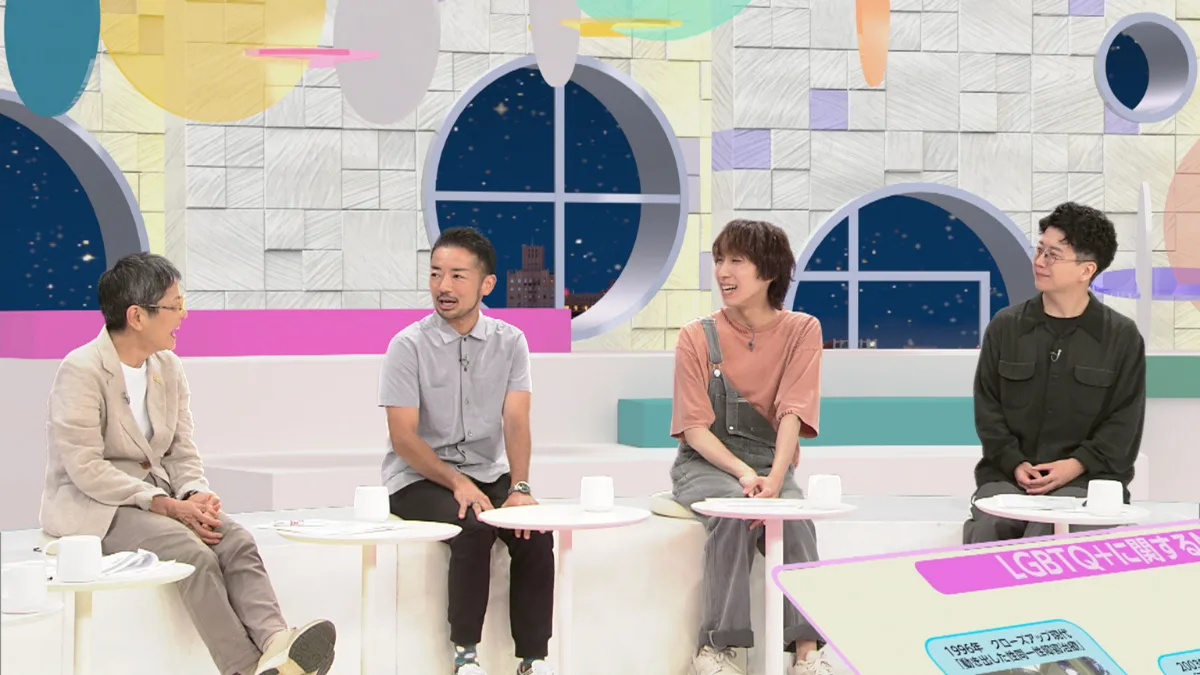
This is even truer when it comes to the portrayal of LGBTQ+ people from the public broadcaster, which carries an authority and enjoys a trust that commercial competitors often aspire to. That is why any discussions on the presentation of LGBTQ+ people in Japanese media must include NHK, and on 20 May 2026, Japan Gay Guide sat down with NHK’s Atsushi Nakano and Shin Yasuda to discuss the company’s history of interactions with Japan’s queer community: how NHK has become a welcoming space for its LGBTQ+ employees, NHK’s plans to celebrate Pride Month, and the corporation’s long and evolving depiction of queer people on screen.
NHK Today
The Voice of Japan
Fully named Nippon Hōsō Kyōkai (Japan Broadcasting Corporation), NHK’s origins stretch back to 1925, with the formation of the Tokyo Broadcasting Station, the Osaka Broadcasting Station, and the Nagoya Broadcasting Station. In 1926, these three entities were merged to create NHK, modeled on the structure of the UK’s BBC.
As you can imagine, with all the changes that have taken place over the past 100 years, NHK has itself undergone many evolutions and transformations, both internally and in terms of the content it produces, especially for content that is both about — and in the late 20th and early 21st Centuries — for LGBTQ+ people.
“I think that media has an important role in letting people know that LGBTQ+ people exist,” says Atsushi Nakano. “It’s also important for LGBTQ+ people themselves because it tells them that they have a place here, and that they belong in our society.”
Promoting LGBTQ+ Awareness
Nakano is NHK’s Principal Program Director for Program Production Center 1 Welfare division of the Content Production Department, where he works to create social welfare programming, best exemplified by its Heart-Net TV series. He develops programs that highlight the issues facing minority groups, such as the disabled, foreigners, the poor, and, of course, the LGBTQ+ community.
Starting his career in 2006 as an announcer in Okinawa, Nakano transferred in 2010 to Kagawa Prefecture, where he made several LGBTQ+ friends, before coming to Tokyo in 2014. It was in 2017 that he organized an LGBTQ+ study group within NHK for fellow announcers to better understand the issues they were discussing, and exchange thoughts and ideas. They were aided by an LGBTQ+ employee, and this reinforced the group’s belief that LGBTQ+ people could not just be thought of in abstract terms at NHK: they were their colleagues and friends.
At that time, there was growing interest in the LGBTQ+ community from non-LGBTQ+ people as a result of the changes that were rapidly taking place in the world. In 2014, same-sex marriage was legalized in the UK, and in 2015, it was legalized across all 50 US States. That same year, Shibuya started Japan’s first Partnership Oath System, which — while not backed by the force of law — gave same-gender couples a certificate that can be helpful for issues such as housing and medical care. Soon after the formation of the informal group, membership slowly began to grow, thanks to both NHK employees wanting to learn more about LGBTQ+ issues, and the steady and repeated attempts by NHK allies to organize study groups and webinars.

Today, the group has become a vital part of work life for many LGBTQ+ NHK employees and allies, as Shin Yasuda can attest. Yasuda is the Head of International Co-production and Acquisition at NHK’s Content Value Development Center, and he joined the group in 2020.
“I have a British partner, who I have been with for twenty years now, and after we got married, I took the opportunity to come out to my colleagues,” Yasuda says. “Until then, I had been reluctant to involve myself in projects that were related to LGBTQ+ issues, because I was worried that I might be outed. But the existence of the group gave me a lot of reassurance, and when I did come out, they all supported me, just as I thought they would.”
Indeed, Yasuda went on to organize a webinar, where he not only let other members know about his sexuality, but also discussed how other companies were making efforts to support their LGBTQ+ employees — and it was following this webinar that the group became formally known as NHK Ally. Today, NHK Ally numbers roughly 240 members across Japan, and it wasn’t long before it began to make a number of tangible achievements for the corporation’s LGBTQ+ employees, in addition to its information sharing work.
Nakano, who is straight, is unmarried but has been in a relationship with his partner for many years, and receives benefits recognizing this by NHK. However, at the time, similar benefits weren’t extended to same-gender couples — a situation he couldn’t understand.
“At that time, during my research, I noticed that a number of local municipalities and some corporations were starting to have internal policies in support of LGBTQ+ issues, but there was nothing to speak of at NHK,” Nakano says. “There was no recognition of same-sex couples, or an official liaison to speak to if you wanted someone to consult about related problems.
“After we organized a webinar where we invited representatives from other companies to talk about their LGBTQ+ support systems and benefits, NHK’s management reached out to us and consulted with us on how to recognized same-sex couples and extend the existing benefits to them. In June 2021 it was announced that same-sex couples can also apply for benefits.”
NHK at Pride

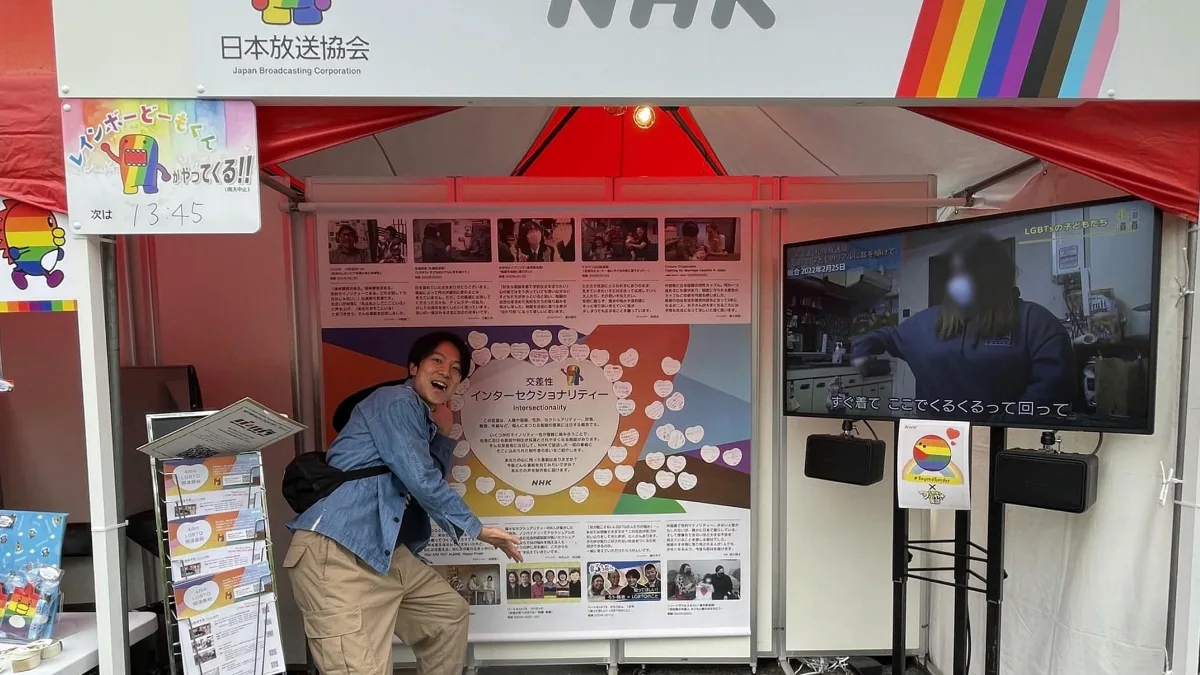
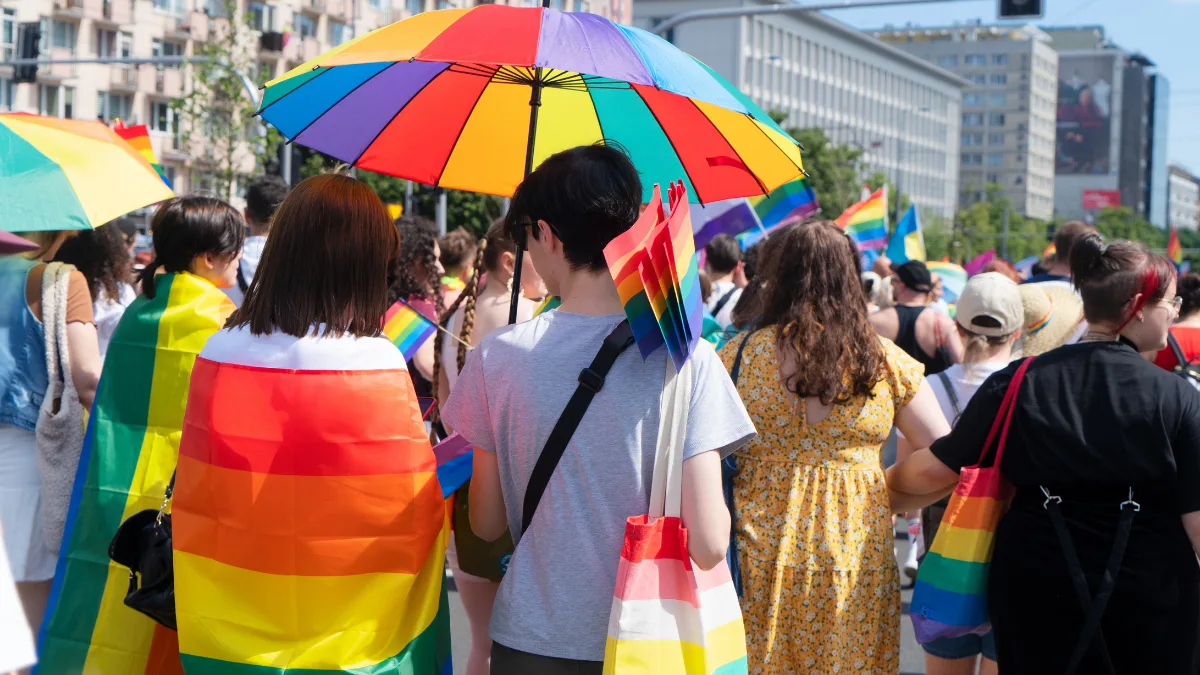
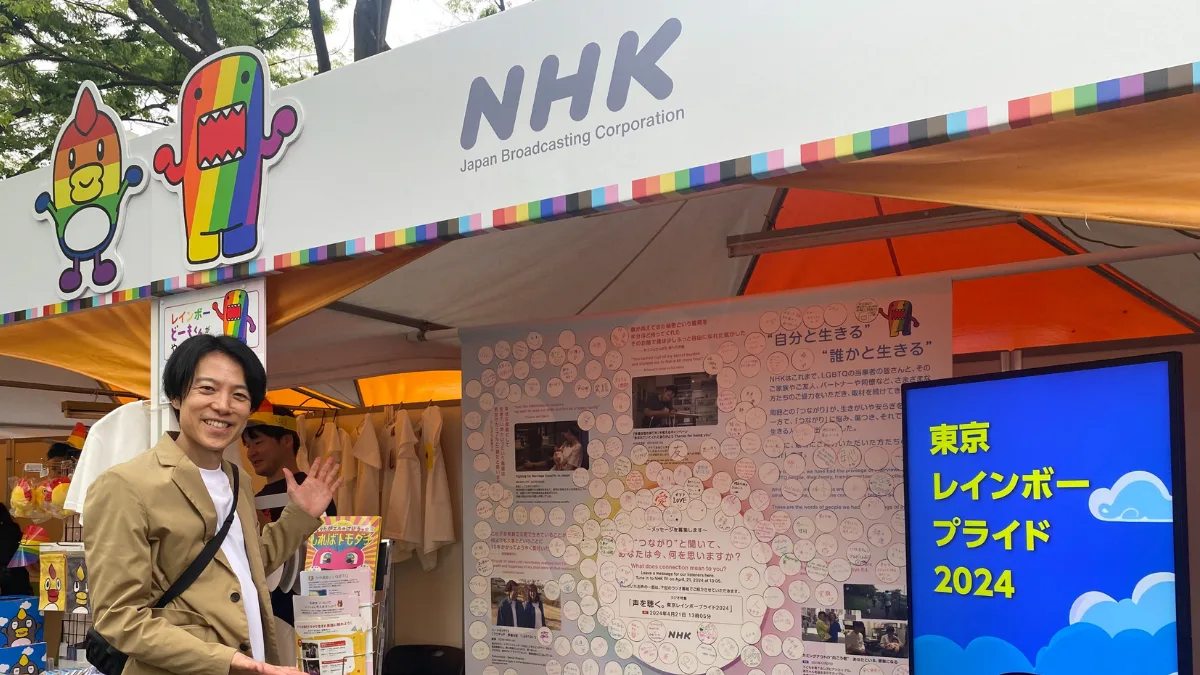
Another major accomplishment of NHK Ally was arranging for NHK to have its own booth at Tokyo Rainbow Pride 2022, the first in-person Pride Festival following the start of the Covid-19 pandemic. It has had a booth at Pride every year since, and always makes a big effort to connect with its LGBTQ+ audience face-to-face.
“One of the most important things about having an NHK booth at Pride is that it gives us the opportunity to speak directly to our viewers and fans, to find out what they care about, what they like about our programs, what they would like to see, and what their worries are,” Nakano explains. “And that includes allies, not just members of the LGBTQ+ community themselves.”
As an example of their eagerness to get feedback, visitors to the booth can submit written messages of their thoughts on NHK and its LGBTQ+ programming, some of which will be read out on June 8, the day after Tokyo Pride, on NHK AM’s Manmaru radio program.
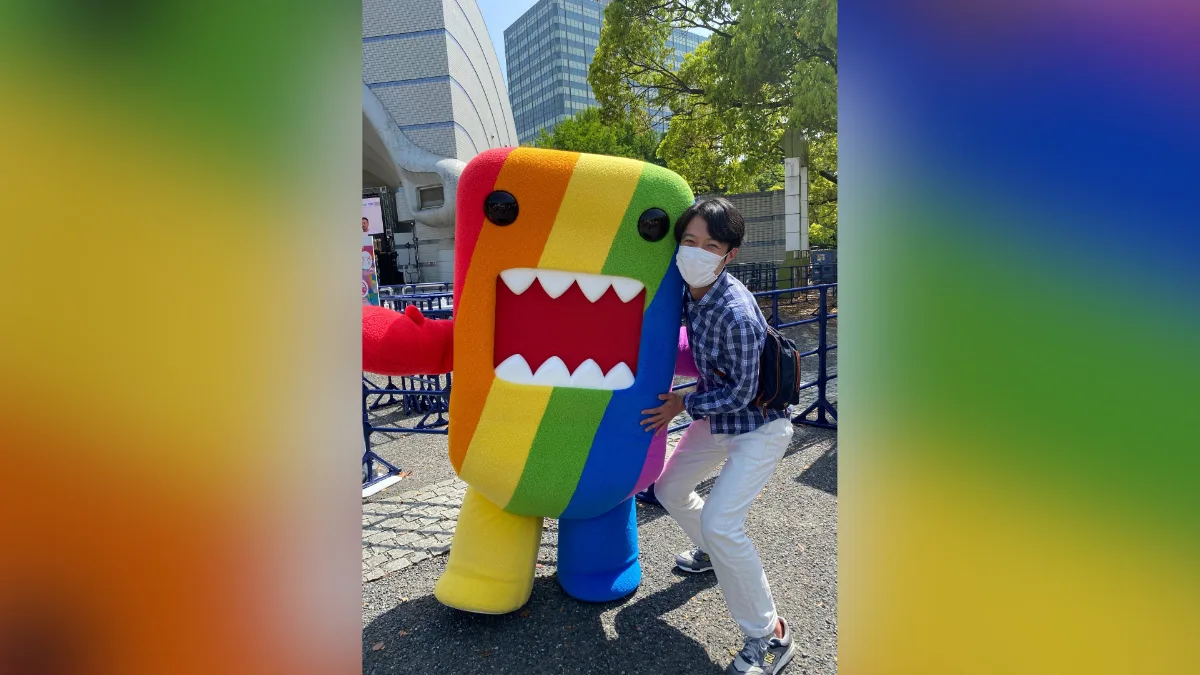
Arguably the most fun thing to do at NHK’s Pride booth is getting to meet the broadcaster’s mascot, Domo-kun, who will be rocking up to the festival covered in the rainbow colors. Lines to grab a photo with the beloved character can get pretty long, so you should make sure you get there early!
The real jewel in the crown of NHK’s Pride booth this year, however, is a special exhibit that examines the LGBTQ+ programming that has been produced over the years. NHK has been very forthright about the representation of queer people over the decades — including some shows that, looked at today, are more than a little insensitive. You can discover this fascinating history first-hand at NHK’s Pride booth, but allow us to give you a sneak preview.
The Evolution of NHK’s LGBTQ+ Coverage
In the Beginning

The exhibit at the NHK booth is based on the program, 100 Years of Broadcasting: LGBTQ+ and the Media, developed for Heart-Net TV, and was produced by Nakano himself. Describing the nature and coverage of LGBTQ+ issues, he notes that depictions were not always as inclusive and positive as they are today.
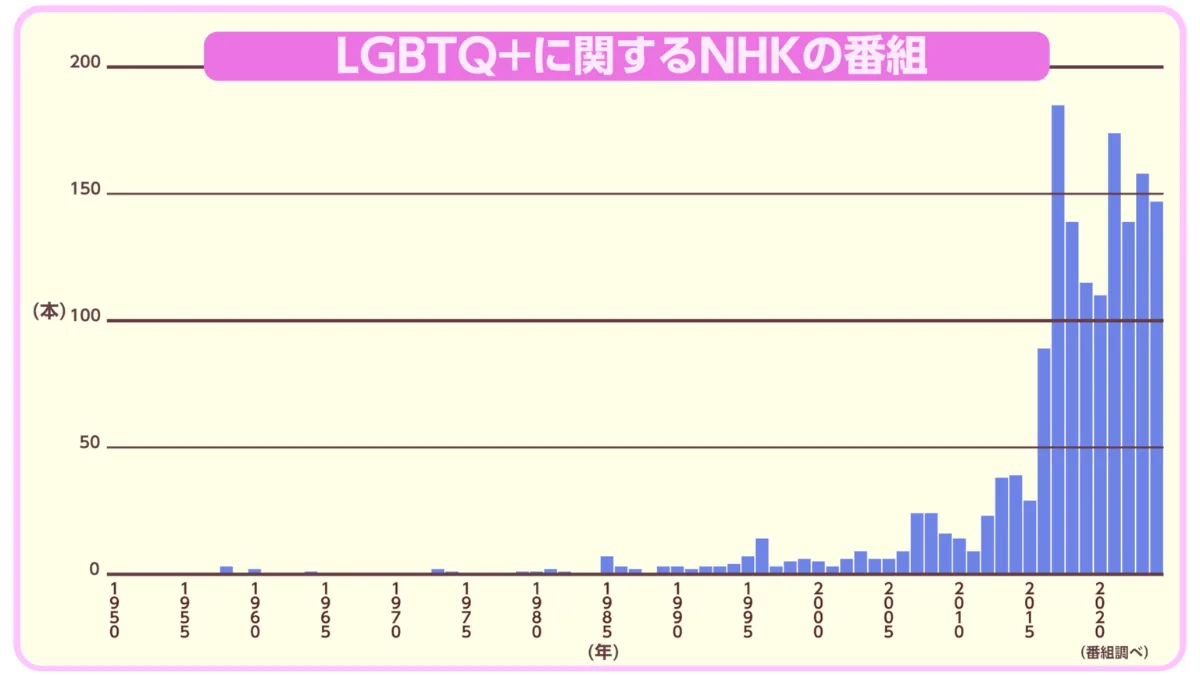
“This is a graph, showing the number of shows that were about LGBTQ+ people broadcast by NHK over the years,” he explained. “As you can see, early on, they weren’t visible in Japanese media. Of course, people knew that they existed, but they were often considered to be ‘invisible’ in society.”
In addition to the lack of visibility, another difficulty that queer people faced during Japan’s post-war was 如何 they were portrayed. Those few programs that were broadcast by NHK, especially in the 1950s and 1960s, were not often sympathetic to the subject matter of LGBTQ+ people, culture and society.
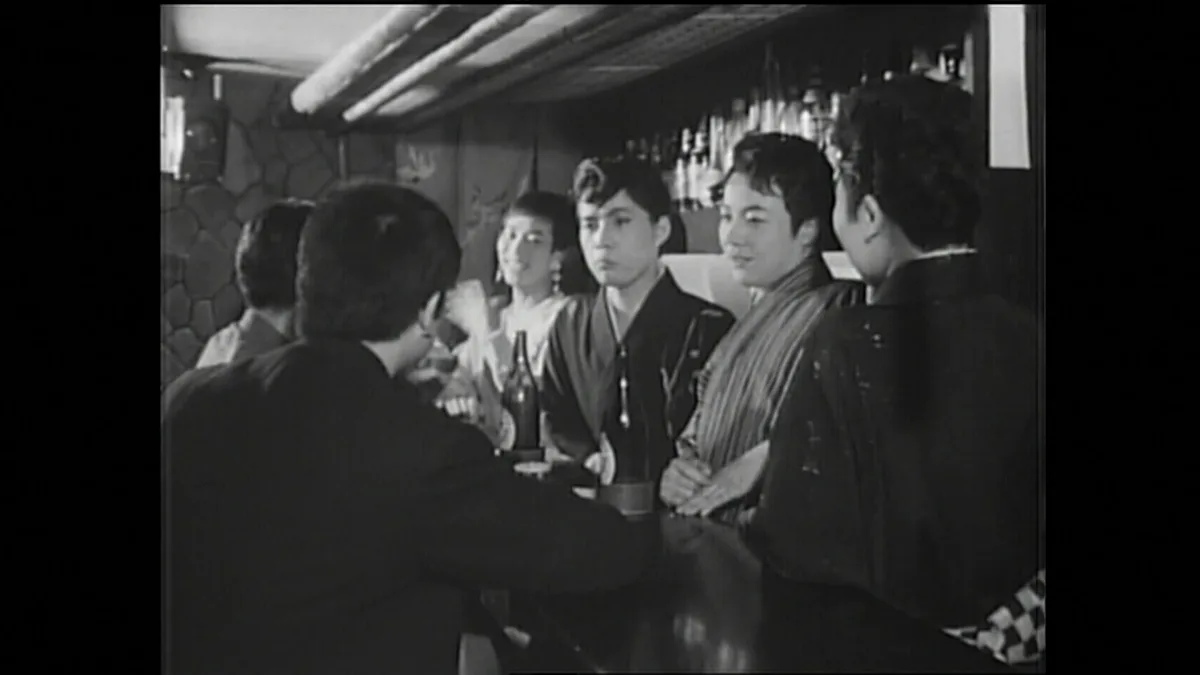
“Looking at two shows from 1958, we can see that they are effectively documentaries about gay bars, and they go into gay bars in the programs,” Nakano says. “When you watch it, terms such as “冈山,” that are highly derogatory, are even used by the narrator. It describes gay life as something twisted, and it’s a pretty voyeuristic program.”
While this was reflective of the attitudes of the time (in the UK, the BBC’s own history of its LGBTQ+ coverage similarly notes that initial reporting on homosexuality considered it to be a “problem”), it nevertheless makes for viewing that is offensive today.
“Media at the time didn’t know better. Media as a whole didn’t have much understanding, and wasn’t educated on the subject,” Yasuda says. “That’s why it’s important for us to acknowledge our past, be humble, and recognize that we don’t know everything. We must face our past and say, ‘we have to continue learning, and we have to be better.’”

Developments At the Turn of the Century
As times and attitudes changed, LGBTQ+ characters came to be depicted more frequently in Japanese media. However, as was the case in media in the west, they would often be used as subjects for comedic purposes, without much insight into what their lives were like, either internally or in society as a whole.
As queer people began to become more visible, however, things began to change. A major turning point for Japan’s portrayal of LGBTQ+ citizens came in 2006, when an episode of NHK’s program Let’s Connect Hearts — which was a predecessor of today’s Heart-Net TV — featured a special episode on LGBT people. In this show, gay, lesbian, and transgender people were not described from the outside through narration, but instead spoke directly about their lives, their struggles, and their joys.
This edition of Let’s Connect Hearts proved to be a huge success. LGBTQ+ people candidly expressing their feelings in a way that was open and direct stood out against the aforementioned stereotypes that were prevalent at the time (we must not forget that Masaki Kumitani’s ‘Hard Gay’ was a popular character in Japan in 2006). Not only this, but the people featured on the show were not LGBTQ+ celebrities or public figures, but ordinary members of the public. The honesty and bravery that they broadcast won the hearts of audiences, and even helped encourage a career in activism.
“This kind of program was unprecedented at the time,” Nakano says. “It helped a lot of LGBTQ+ people, who said they felt lifted after seeing it, as they could see that they weren’t alone. This program also actually featured a transgender man who today is one of Japan’s leading activists for LGBTQ+ rights. He told us afterwards that not only was being able to speak about his experiences cathartic, but also that he got a lot of support from the viewers, and was able to connect with a number of LGBTQ+ people after the show.”
Diversity in LGBTQ+ Programming

Over the following years, NHK and other media outlets have gone on to produce a number of programs centered on LGBTQ+ people in Japan. As mentioned, at the same time that NHK Ally was taking shape, public interest in the LGBTQ+ community and its issues was at a high, and so a number of different programs began to be produced. Nakano notes that 2017 was the high watermark for LGBTQ+ shows being broadcast by NHK, and though there are fewer today, there are still far more than even 15 years ago.
With the rise in interest, formats similar to Let’s Connect Hearts and documentaries came to dominate programming about sexual minorities in the 2010s.
“As society was beginning to recognize LGBTQ+ people, the number of programs gradually started to increase,” Nakano confirms. “In the second half of the 2010s, these would cover the basics of the ‘LGBT’ part of the spectrum. Then, as we moved into the 2020s, we saw more focus given to the ‘Q+’ part, such as asexual people and more. These programs proved that there is much more diversity within the topic than many people thought.”
The 2020s also saw a highpoint for fictional programs that highlighted LGBTQ+ characters and communities. NHK is famous for its high-quality dramas, and since 2020 it has broadcast a number of original shows, as well as adaptations of popular manga. These titles include major fan hits, such as: 我哥哥的丈夫, which sees the lead character coming to terms with both his brother’s passing, and learning to accept his brother’s widower, a man from Canada; and She Loves to Cook, and She Loves to Eat, in which a young woman who loves cooking but has a small appetite develops a relationship with a woman who has a large appetite, but doesn’t cook much.
One interesting thing about the two titles highlighted here (in addition to their critical and commercial success) is that they feature characters who are more full-figured than may be typical of some other drama series. Nakano makes it clear that things like this are important not only to show the wide variety of LGBTQ+ people who exist in Tokyo, but also to show that they are, first and foremost, people.
“Obviously, different body representation is important to us, but we think it’s also important the LGBTQ+ aspect doesn’t become to sole focus of a drama,” he says. “We’re starting to see characters within stories who happen to be gay or lesbian, but that part doesn’t define the drama. Nuanced representation is very important.”
One recent example is the 2024 morning drama, The Tiger and Her Wings. The drama is based on the story of one of the first women in Japan to become a lawyer, and one of her best friends in the show is gay.
“Morning dramas are appointment viewing for the majority of the Japanese population, and when it aired, we got a very positive response from our audience,” Nakano says.
Confronting Challenges
Nevertheless, NHK is not resting on its laurels following the success of these programs. While the broadcaster has come along leaps and bounds since its first documentary on gay bars in the 1950s, there are still issues when it comes to elevating LGBTQ+ voices that need to be addressed.
“As a gay TV producer myself, I think one of the big challenges we have is: how do we get more LGBTQ+ representation behind the camera?” Yasuda says. “We’ve made big efforts increasing representation in front of the camera, but in the production space, we still need more inclusivity. I think there are still a lot of people afraid to be out in a Japanese workplace. There’s still a lot of work to be done in making sure that LGBTQ+ directors, producers, camera operators, editors, sound designers, and others can feel safe and comfortable in voicing their opinions.”
“It’s also important for us to remember, as a nation-wide broadcaster, that many of our viewers live in rural communities, far away from cities like Tokyo,” Nakano adds. “Every community will have its own unique issues, and it can still be the case in rural Japan that a lot of stereotypes about LGBTQ+ people persist, so we have a responsibility to make sure that queer voices from those communities are also heard.”
Luckily, these are not issues that NHK has to face alone. As the state broadcaster, NHK may be the most visible Japanese broadcaster (especially to overseas audiences), but Yasuda reminds us that media in Japan as a whole has come a long way. This year, he says, NHK will be marching alongside commercial networks, such as Nippon TV, Fuji TV, TV Asahi, TBS, and Tokyo TV as part of the Media Rainbow Allies as they walk as one with the aim of providing high-quality LGBTQ+ broadcasts, not only during Pride Month, but all year long.
NHK’s Pride Month Programming

To celebrate Pride Month, NHK is showing its dedication to its LGBTQ+ audience by giving many of its most popular shows repeat broadcasts. This means that audiences who didn’t get the chance to see them the first time around will have a second chance in June.
These programs will include:
- Heart-Net TV100 Years of Broadcasting: LGBTQ+ and the Media, so you too can see the history of NHK’s LGBTQ+ programming, and the earliest programs made on the subject. Broadcast on Tuesday, June 16 at 20:00 on NHK ETV. Rebroadcast on Monday, June 22 at 15:00 on ETV.
- Nanbun no Ichi (One in How Many?): 1/156 Transgender is a five-minute documentary that aims to reveal contemporary Japan through the framing of a particular This episode focuses on the life of a transgender person. Broadcast on Thursday, June 4 at 19:55 on NHK ETV. Rebroadcast on Friday, June 5 at 23:50.
- TOKAI DO-MANNAKA! “Thank you for being you”LGBTQ+ features Japanese LGBTQ+ celebrities and athletes who send letters to loved ones expressing, “thank you for being you.” Broadcast on Saturday, June 6 at 24:40 on NHK ETV.
- Niji-kuro – Rainbow Closet: “I’m held back by society’s expectations” follows Shu, 18, who confides in LGBTQ+ mentors. Shu wants to wear cute clothes but feels held back by society’s expectations of what boys should be like. He opens up about his feelings while doing makeup with Baku Ikegami, a “genderless” model. Broadcast on Monday, June 22 at 20:00 on NHK ETV. Rebroadcast on Monday, June 29 at 14:30 on NHK ETV.
- Niji-kuro – Rainbow Closet: “Can’t image life with a same-sex partner” follows Minori, 19, who is attracted to both genders. By having conversations with the mentors and a couple in their 40s, Minori explores relationships and life with a same-sex partner. Broadcast on Tuesday, June 23 at 20:00 on NHK ETV. Rebroadcast on Monday, June 29 at 15:00 on NHK ETV.
- MANMARU is a live radio program that delivers real-time conversations connecting listeners nationwide. Messages collected at the Tokyo Pride NHK booth will be introduced. Live broadcast starts at 12:30 on Monday, June 8 on NHK AM Radio.
The beginning of NHK’s Charter of Ethics and Code of Conduct reads: “Our mission is to contribute to the advancement of democracy and culture by delivering accurate, reliable information and rich, high-quality programming to all.” When it comes to coverage of Japan’s LGBTQ+ population and culture, we have seen how fulfilling this mission has been imperfect, and that it is an ongoing journey. There are still problems to be overcome that can be identified today, and no doubt issues will arise that we cannot foresee today. But we can also see how, even in just the past decade, NHK has made major strides when it comes to including and elevating LGBTQ+ voices, both in the corporation and on screen, as Japan and its institutions have become more inclusive, representative, and sensitive to people’s needs and views.
Make sure to make the time to visit NHK’s booth at Tokyo Pride 2026 — and for more information on the things you can see and do at the Pride Festival and beyond, check out our Tokyo Pride 2026 Ultimate Guide below!