
Finding Your Home in Japan: LGBTQ+ Friendly Housing

托比亚斯-沃特斯

As our beloved readers may be aware, Japan does not yet recognize marriage equality, and so many facets of law that would protect straight married couples do not apply to same-gender couples. However, you may also be aware that the Partnership Oath System, which has been adopted by the vast majority of wards, cities, and towns in Japan, can and have helped many people to get access to the services they need.

However, the Partnership Oath System is, sadly, not backed by the force of law, only social pressure — and Japan currently has very few anti-discrimination laws. As such, it is still the case that LGBTQ+ couples can have difficulty finding reliable housing. Today, we’ll be discussing some problems that have been reported, as well as efforts to overcome them. We’d like to acknowledge our gratitude to the Mainichi Shimbun for their reporting on this issue.

Housing Problems Faced by Queer Couples

Although awareness of LGBTQ+ issues and people are perhaps more widely discussed in Japan than ever before, the issue of housing continues to be a problem for many queer people in Japan. Professor Risa Kuzunishi of Otemon Gakuin University, who has been researching housing issues for over 25 years, turned her attention in 2022 to the troubles faced by the LGBTQ+ community in finding rental accommodation, expanding on her research regarding single mothers.

She discovered that even among LGBTQ+ people who were now housed, many had faced difficulties in the past. One thing that many found especially irritating was that many would go through the fairly long and arduous process of finding a place to live in Japan, even up to the point of viewing the property, and expressing their desire to rent it, find after they disclose that they are LGBTQ+ that they face extra paperwork, or are told to lie about their relationships.

图 11
消息来源Suumo

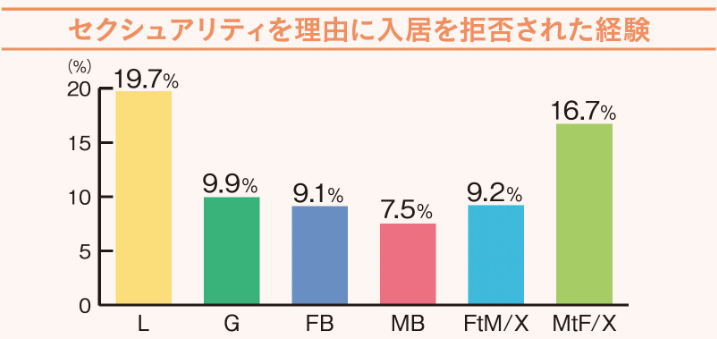
Indeed, a survey conducted by Dr. Kuzunishi discovered that just over 12% of respondents had experienced difficulties in finding a place to live. This was most pronounced among lesbians, 19.7% of whom reported discrimination, and trans women and/or assigned male at birth X-gender people, 16.7% of whom said they had been discriminated against.

What was interesting to note, however, was that in most cases, it appeared that it was not the real estate agency that was making things difficult, but rather the property owner — the landlord. Japanese culture of not wanting to cause trouble meant there could be a form of “preventative refusal,” with the agent not wanting to bother the landlord, or the landlord saying that, as they were unfamiliar with having a queer tenant, they didn’t think they could accommodate their needs (though one wonders how sincere this reasoning is).

One legitimate issue that landlords might face, however, is that without marriage equality, what happens if the contract holder dies? Who inherits responsibilities — or if the property has been bought outright, who inherits the house? These are issues that derive from the (in our view) unconstitutional position that marriage is only between men and women. Once more, recognizing same-gender marriage would solve yet another problem that exists only for the sake of existing.

Suumo and Their Efforts to Prevent Discrimination

图像 13
消息来源Suumo

Suumo, a subsidiary of Recruit, is arguably the best known platform for finding housing in Japan — its distinctive “Suumo, Suumo, Suuuumo” song from its commercials gets in your head and won’t be getting out any time soon. It takes its market position and reputation seriously, and has been working to make sure that all its clients are satisfied.

In 2017, it became the first platform to offer “LGBT-friendly” as a category on its website. This helps both the landlord and real estate agent serve the potential renter to be aware of who wants to rent the property, and who they will be renting it with.

In 2021, it launched the “100Mo!” project, based on the idea of “100 homes for 100 people,” reflecting its intention to find suitable housing for the foreigners, the old, the disabled, and, of course, the LGBTQ+ community. In June 2025, it ran a campaign during Pride Month to try and raise awareness of housing that was LGBTQ+ friendly, offering free stickers and Suumo stuffed toys holding rainbow flags to real estate agencies who advertized queer-friendly housing.

In addition, Suumo has created a short textbook to let its employees know how to act ina way that helps LGBTQ+ people feel comfortable when seeking housing advice, from initial customer service at the office, to guidance searching for an apartment, to contract signing, to help improving the general quality of customer service.

结论

Japan has quite a way to go until discrimination is at an end. Although there are societal mores and pressures that discourage prejudice today — far more than in the past — it is still the case that without the full recognition and backing of the law, LGBTQ+ people can still face difficulties. It is good to know, however, that companies like Suumo are out here doing their best to make a country where LGBTQ+ can find a place to live that isn’t just a house, but a home.

托比亚斯从事编辑和作家工作已有十余年,最初在伦敦一家法律出版社工作,2019 年移居东京。 搬到日本首都后,他撰写或编辑了各种主题的文章,包括汽车、医药、电子游戏、经济、葡萄酒、教育和旅游。他甚至评论了日本推出的首款 CBD 啤酒! 业余时间,他喜欢看电影、玩电子游戏、唱卡拉 OK 和去当地的温泉。他最喜欢的神奇宝贝是神狐,最喜欢的食物是咖喱。他从不谈论 2008 年金融危机如何影响了现代世界的一切。