


Japanese Supreme Court Agrees to Hear Appeal on Gay Marriage
After a number of high court rulings — of various degrees of justice — finally, the Japanese Supreme Court has confirmed that it will make a ruling, this (financial) year, has confirmed that it will rule on the legality of marriage equality in Japan. How did this come about? Why is it important for LGBTQ+ people? And why is it happening now? We’re gonna take you through it, bestie, so no worries! Stand to attention for your judge, and let me detail the case!
What Were The Previous Trial Results?
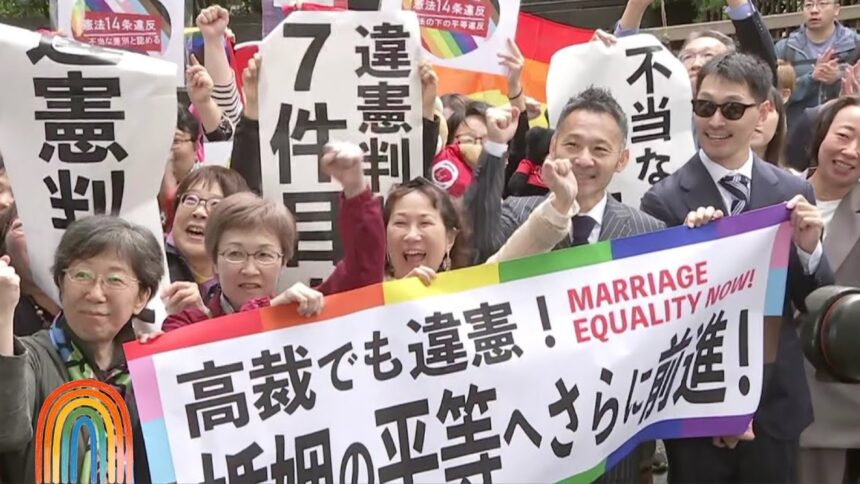
There have been six previous high court trials that have addressed the need for marriage equality. These were, for the most part, supportive of the interpretation that a lack of same-gender marriage violates the Japanese constitution. However, the Tokyo High Court made a surprising ruling last year — with a reasoning that even those who are opposed to marriage equality found to be bizarre.
Part of the reason that the ruling of 28 November came as a surprise to many is that, over the past few years, in addition to growing public support for marriage equality, there have been a number of District Court and High Court rulings in Japan that have affirmed that Article 24 of the Japanese Constitution, which defines marriage as a union between one man and one woman, are in violation of Article 14, which guarantees equality.
We have a more detailed article about the recent history of these decisions here. In short, given the multiple affirmative decisions given by High Courts across Japan over the past few years, this ruling was not expected to be significantly different. Regrettably, this turned out not to the the case.
Why Is This Coming to the Japanese Supreme Court?

Well, when five High Courts agree on one thing, one one other doesn’t, it’s kind of a big deal — especially when the dissenter is Tokyo. So, we need to have a decision. Under the Constitution of the State of Japan, is same-sex marriage legal?
Well, according to Article 24, marriage is between “the two sexes.” But Article 24 is not the only article of the Constitution. Let us consider also article 13, which says:
“All of the people shall be respected as individuals. Their right to life, liberty, and the pursuit of happiness shall, to the extent that it does not interfere with the public welfare, be the supreme consideration in legislation and in other governmental affairs.”
And let’s not forget Article 14, which says: “All of the people are equal under the law and there shall be no discrimination in political, economic or social relations because of race, creed, sex, social status or family origin.”
“All of the people.” No exceptions. That is why Tokyo’s High Court ruling that forbidding same-gender marriage was so strange. And that is why it’s going to the Supreme Court of Japan.
How Do We Expect the Trial to Go?
Honestly, we don’t know. Articles 13 and 14 seem to be proof that Article 24 should be overridden. Especially since we at JGG believe, as many do, that Article 24 was designed to stop arranged and abusive marriages.
But we can be real about it. This is a big deal for the LGBTQ+ community. The Supreme Court is the final arbiter of the law. How it comes to its decision — and what decision it will make — are of crucial importance to queer people. If the decision is to prioritize Article 24 over the rest of the constitution, then it must follow that the rights to be respected as individuals, as well as the right to not be discriminated against, are no longer inviolate. This would be a monumental problem.
Regrettably, we have no lawyers on our staff. But it seems, frankly, unacceptable that marriage equality would not be accepted.
JGG’s position is: marriage rights for queer people today, tomorrow, and forever.