


Japanese works differently from English when it comes to personal pronouns.
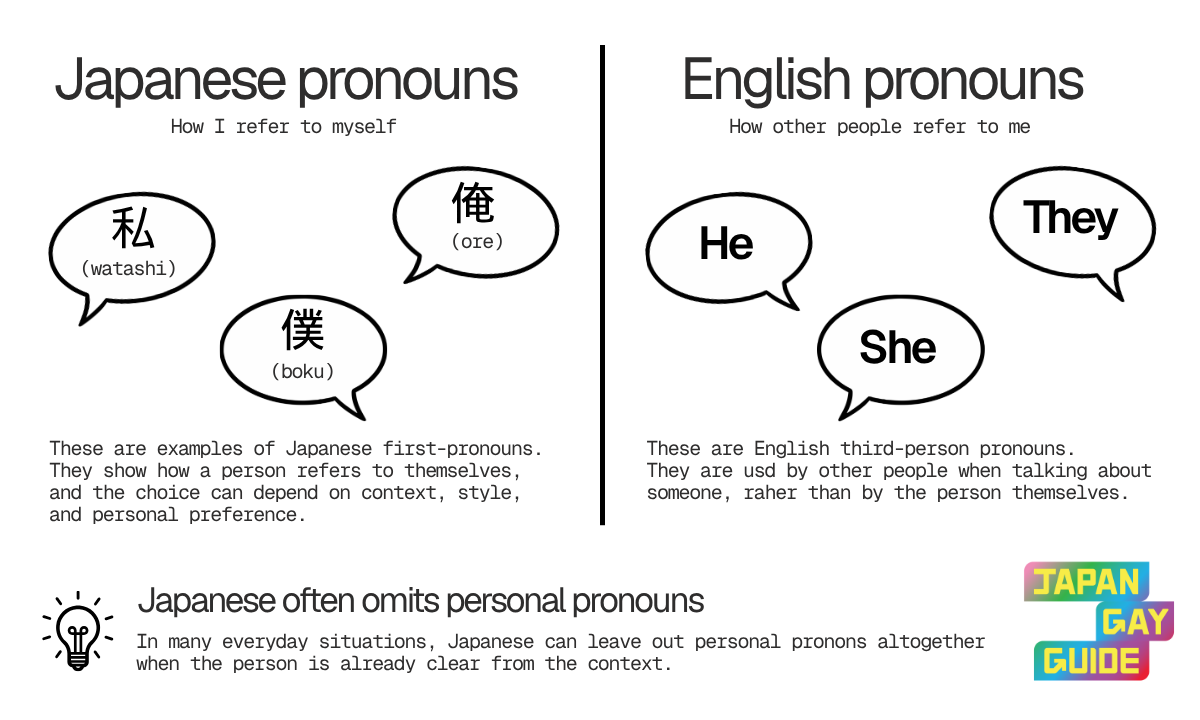
Words such as watashi (私, わたし), boku (僕, ぼく), and ore (俺, おれ) are mainly ways of referring to yourself. Japanese also often leaves personal pronouns out completely when everyone already knows who is being discussed.
In English, saying ‘my pronouns are he/him’, ‘she/her’, or ‘they/them’ usually tells other people how to refer to you. You might see pronouns shared at work, on TV, on social media, or in everyday conversation.
Japanese first-person choices can carry associations with gender, formality, age, social position, and setting. But they are not simple identity labels. A person using boku is not automatically a man, just as someone using watashi is not automatically a woman.
That difference matters when talking about Japanese, gender, and LGBTQ+ identities.
This guide explains how Japanese pronouns work, the main ways to say ‘I’, what those choices can signal, and why English he, she, and they do not always have a direct Japanese equivalent.
How Japanese Pronouns Differ From English
Japanese does have personal pronouns, but they are used differently from their English equivalents. A simple way to understand the system is to divide them into three groups.
First Person Pronouns
For first person, speakers can use forms such as watashi, boku, and ore to refer to themselves. For ‘we’, a word such as watashitachi (私たち, わたしたち) can be used when the group needs to be made clear.
Second Person Pronouns
For second person, anata (あなた) is the form many learners first encounter for ‘you’. However, in everyday Japanese, names, surnames, titles, and social roles are often used instead. The pronoun can also be left out when the person being addressed is clear.
Third Person Pronouns
For third person, kare (彼, かれ) and kanojo (彼女, かのじょ) broadly correspond to ‘he’ and ‘she’. Plural forms such as karera (彼ら, かれら) can refer to groups of people.
The important difference is that Japanese often does not need to say who is doing something. If the subject is already clear from the conversation, it can disappear from the sentence. This applies to ‘I’, ‘you’, ‘he’, ‘she’, and other personal references.
For example, an English speaker might say:
‘I went to the shop. I bought a drink.’
In Japanese, someone can say:
店に行って、飲み物を買った。
Mise ni itte, nomimono o katta.
‘Went to the shop, bought a drink.’
The natural English translation supplies ‘I’, but the Japanese sentence itself does not state who went to the shop or bought the drink. The speaker can leave out the subject because the context makes it clear they are talking about themselves.
The same feature means Japanese does not always require a speaker to choose between a gendered ‘he’ or ‘she’. A person’s name, title, family role, or the surrounding context may make the meaning clear without any third-person pronoun at all.
This is why translating Japanese pronouns directly into English can be misleading. Watashi, boku, and ore are first-person forms: they describe how someone refers to themself. They do not directly answer the English question of which third-person pronouns other people should use for that person.
That distinction becomes especially important when looking at the many ways Japanese speakers can say ‘I’.
Watashi, Boku, Ore, and Other Ways to Say ‘I’
Japanese has several common first-person forms, and each can carry different social associations. These may relate to formality, masculinity or femininity, age, region, social group, and the image a speaker wants to present.
Research by Timothy Yee and Jock Wong examines six common Japanese first-person forms: ore, watashi, jibun, boku, atashi, and uchi. Their analysis looks at why some of these forms are heard as more masculine or feminine. Rather than treating them as direct markers of biological sex or gender identity, the research connects those impressions to traits that Japanese society has traditionally associated with gender.
The following table gives a practical overview of those six forms, plus watakushi (私, わたくし). These are social conventions, not rules about who is allowed to use each form or what gender someone must have.
| Japanese | Reading | Common Association | Important Context |
|---|---|---|---|
| 私 | watashi | Polite and broadly usable. Can be associated with women in some casual settings | A useful starting point in formal, polite, or mixed situations |
| 私 | watakushi | Very formal and polite | Used by people of different genders, especially in formal or ceremonial settings |
| 僕 | boku | Masculine-associated. Softer or less forceful than ore | Can signal youthfulness, approachability or polite informality, depending on context |
| 俺 | ore | Strongly masculine-associated and informal | Often linked with casual, assertive, or rougher masculine presentation |
| あたし | atashi | Feminine-associated and casual | Commonly associated with feminine speech, but usage varies between speakers and settings |
| うち | uchi | Casual and strongly associated with particular regions and social groups | Particularly common in western Japan and some youth or community contexts. Not a universal replacement for watashi |
| 自分 | jibun | Context-dependent. Can be associated with particular groups and settings | Has a major ‘self/ oneself’ function and can also be used for first-person reference in particular contexts |
Watashi and Watakushi
Watashi is one of the most widely useful first-person forms. It can be used by people of different genders, particularly in formal or polite situations.
In casual speech, watashi can have a more feminine association in some contexts. However, men also use it, especially when speaking formally or professionally. It is therefore better to think of watashi as a form with a broad range of uses rather than a ‘women’s pronoun’.
Watakushi (私, わたくし) is a more formal version. The Digital Daijisen dictionary describes it as a first-person form used when speaking to someone senior or in a more formal situation, and notes that both men and women use it.
Because watashi and watakushi use the same kanji, pronunciation and context tell you which reading is intended.
This makes watakushi particularly useful in situations such as formal speeches, interviews, or very polite professional communication.
Boku and Ore
Boku is conventionally associated with masculine speech. It can sound softer, younger, or more approachable than ore, although its exact impression depends on the speaker and situation.
Ore is also strongly associated with masculine speech, but is generally more casual and can sound more assertive or rough.
The difference is not simply ‘male pronoun versus another male pronoun’. The form someone chooses can also depend on where they are, who they are speaking to, and how they want to present themselves in that setting.
So describing boku simply as ‘the male version of watashi’ misses much of how these forms work in real Japanese.
Atashi, Uchi and Jibun
Atashi is a casual form commonly associated with feminine speech. As with the other forms, that association does not by itself tell you a speaker’s gender identity.
Uchi needs particular care. It has strong regional and social associations and is especially familiar in western Japan. It is also used by particular groups and speakers in casual conversation. It should not be treated as a universal gender-neutral Japanese equivalent of ‘I’.
Jibun is even more context-dependent. Its basic meaning is ‘self’ or ‘oneself’. It can work as a reflexive expression, as well as a first-person form in particular situations. Yee and Wong include jibun among the major Japanese first-person forms they examine, while also treating it differently from a simple English ‘I’.
The key point is that these seven forms are not seven interchangeable options that every learner can choose between.
If you are learning Japanese and are unsure what to use, watashi is a broadly useful starting point for polite and formal situations. Boku and especially ore require more awareness of the social setting and the impression they can create. In many everyday conversations, however, the most natural choice may be to leave ‘I’ out altogether.
Do Japanese Pronouns Tell You Someone’s Gender?
Calling boku ‘a male pronoun’ is convenient for beginners, but it is too absolute to describe real Japanese usage.
Boku is conventionally associated with masculine speech. Ore has an even stronger masculine association. Watashi has a wider range of uses, including formal speech by people of different genders.
Those patterns can tell listeners something about how a person’s speech comes across. They are not proof of the speaker’s gender identity.
First-person forms can also communicate age, social position, familiarity, regional background, or the relationship between speakers. The same person may therefore use different forms in different situations.
Research by Shu Min Yuen on Japanese trans communities shows how language choices can shift with social setting and personal circumstances rather than following one fixed identity rule. For example, Yuen describes trans men using ore or boku in some community settings, while some used watashi in professional situations or in contexts where they had not publicly transitioned.
This does not mean that every trans person uses pronouns in this way. It demonstrates something more specific: a Japanese first-person form can carry several kinds of social information at once.
Research from Momoko Nakamura also examines how Japanese first-person forms become connected with gendered language norms, and how speakers can use them in ways that do not always follow those conventions.
The useful distinction, then, is between a form’s social association and someone’s gender identity. The former can shape how a person’s speech is perceived. It should not be treated as proof of the latter.
That becomes even clearer once we move away from ‘I’ and look at how Japanese refers to other people.
He, She and They in Japanese
Japanese has established third-person forms. Kare broadly corresponds to ‘he’, while kanojo broadly corresponds to ‘she’.
Both words can also refer to a romantic partner. Kare can mean a male partner or boyfriend, while kanojo can mean a female partner or girlfriend. Kareshi (彼氏) is another common word for ‘boyfriend’.
For example:
彼は先生です。
Kare wa sensei desu.
‘He is a teacher.’
But:
彼ができた。
Kare ga dekita.
‘I got a boyfriend.’
The surrounding context tells the listener which meaning is intended.
There is another important difference from English. Kare and kanojo are used less often in ordinary Japanese conversation than ‘he’ and ‘she’ are in English.
For example, instead of repeatedly saying:
‘She went to the office. She called me later. She said she was tired.’
Japanese might use the person’s name once and then leave the subject out:
田中さんは会社に行きました。あとで電話をくれました。疲れたと言っていました。
Tanaka-san wa kaisha ni ikimashita. Ato de denwa o kuremashita. Tsukareta to itteimashita.
‘Tanaka went to the office. Later, she called me and said she was tired.’
The natural English translation repeats the subject because English usually requires one. In Japanese, the later sentences do not need to say ‘she’. The listener understands who is being discussed from the context.
What About Singular ‘They’?
This is where English and Japanese become particularly difficult to compare.
English uses they/them for groups and for a single person whose gender is unknown, unspecified, or non-binary. Japanese does not have one direct equivalent that works in every situation.
Karera is a plural form. It can mean ‘they’ when referring to multiple people. It should not be treated as the Japanese equivalent of singular they.
Instead, Japanese may leave the person’s reference out:
‘They are coming later.’
→ あとで来ます。
Ato de kimasu.
‘Coming later.’
Or the person’s name can be used when it is appropriate:
‘They are working today.’
→ 田中さんは今日働いています。
Tanaka-san wa kyō hataraite imasu.
‘Tanaka-san is working today.’
These are examples of a broader strategy rather than fixed translations. The most natural Japanese wording depends on the situation, the relationship between speakers, and how much information is already understood.
This is why singular they is better understood as a translation problem rather than a missing-vocabulary problem. Someone speaking Japanese can often avoid choosing a gendered third-person pronoun altogether.
How to Interpret Japanese Pronouns Respectfully
The most important rule is simple: do not use someone’s Japanese first-person choice as an identity test.
Someone may use boku, watashi, or another form because it suits the situation, their relationship with the listener, their social group, the way they want to present themselves, or simply their personal preference.
It is more useful to separate two questions:
How does this person refer to themself in Japanese?
and
How does this person want other people to refer to them in English?
The answers do not have to match in any simple way.
For example, someone may use watashi in a Japanese workplace because it fits the setting, while asking English-speaking friends to use ‘he/him’ when speaking English. Another person may avoid first-person pronouns in Japanese almost completely but still have a clear preference for English pronouns.
Japanese speakers also do not necessarily need to use a third-person pronoun every time they refer to someone. Names, titles, and context can often do the job naturally. This can be especially useful when talking about a person whose gender you do not want to assume.
There is no single Japanese phrase that works as a universal equivalent of the English question ‘What are your pronouns?’ Japanese handles self-reference and reference to other people differently, so the appropriate way to ask depends on the situation.
When clarification is genuinely needed, focus on how the person would like to be referred to rather than treating a particular Japanese pronoun as evidence of their identity. If you are also communicating in English, it can be helpful to clarify their English pronouns separately.
For more information about Japanese gender identities outside the male/female binary, see our guide to X-Gender in Japan.

The wider lesson is simple: Japanese pronouns can carry social information, but they do not provide a shortcut to someone’s identity. Pay attention to the language a person uses about themself, follow their stated preferences, and ask when clarification is genuinely needed.
Understanding that difference makes it easier to speak Japanese naturally while avoiding assumptions about the people who use it.