
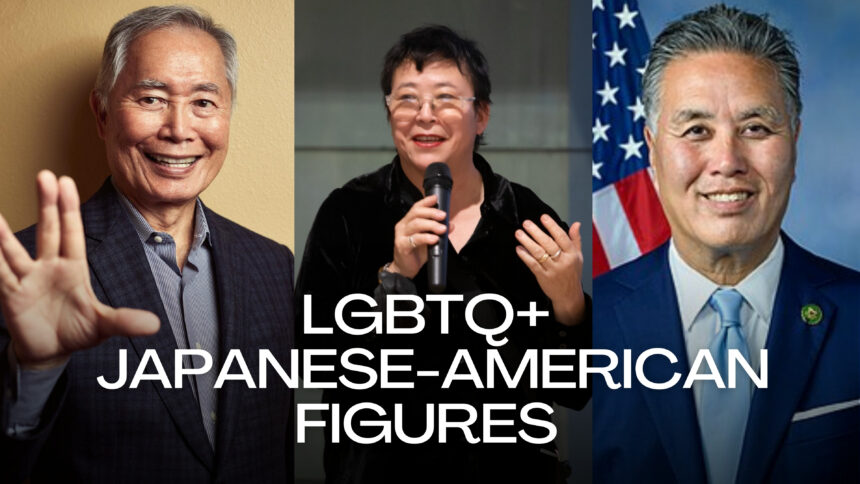
The LGBTQ+ community in Japan has been struggling for rights, respect, and recognition for decades, and rightly so. With marriage equality still not recognized, the fight continues. But what of those of Japanese descent who live in other countries? Many LGBTQ+ second or third generation Japanese immigrants have been struggling for queer rights, too.
This includes a number in the United States of America. So today, despite (or rather, to spite) the increasing homophobia and transphobia under the 47th President, we are going to be highlighting five LGBTQ+ American public figures of Japanese descent.
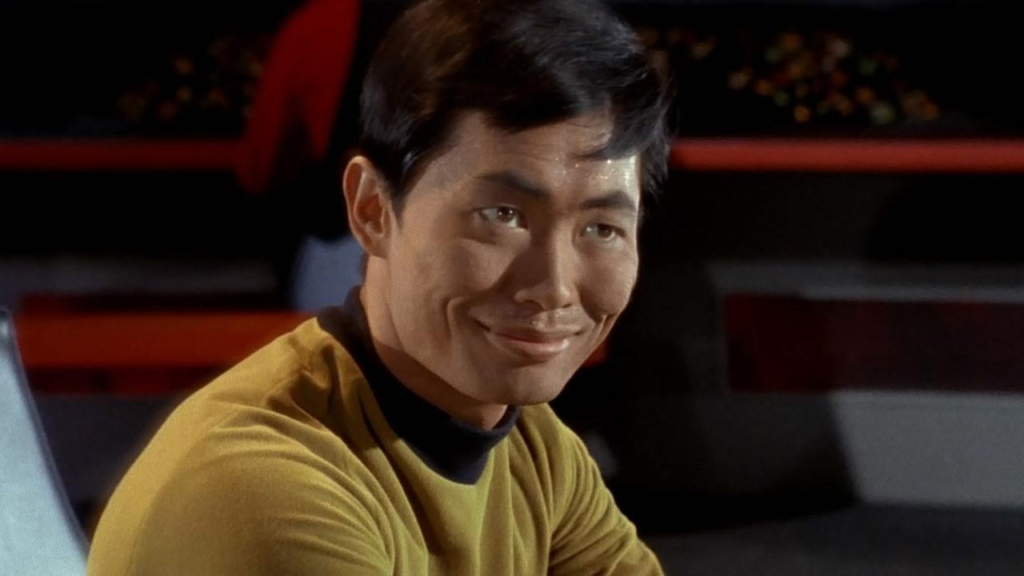
George Takei

Arguably the most visible LGBTQ+ Japanese American, George Takei needs no introduction… but I think he’s cool, so I’m going to give him one anyway. Born in California in 1937, Takei (born Hosato Takei) suffered in his childhood, being held captive with his family in an internment camp as a result of racist US policies against people of Japanese descent during the Second World War.
As a young adult, he began a career in acting, including voiceover work and portraying Japanese-American characters, but found real fame in the role of Hikaru Sulu, the helmsman of the U.S.S. Enterprise in the original Star Trek. A fan-favorite character, his role was expanded, and he has gone on to be one of the most important figures in the history of the show.
In 2005, he came out as gay, and revealed that he had been in a relationship with his partner, Brad Altman, for 18 years at the time. He embarked on an “Equality Trek” tour, discussing his experiences, and was the star of one of the first viral Internet videos on YouTube in 2007, when he made a spoof PSA to mock basketball player Tim Hardaway’s homophobic comments.
Today, Takei is a gay icon, not just among Japanese-Americans or Asian-Americans, but across the world. His consistent kindness, consideration, and advocacy for LGBTQ+ people has meant that his has an even more important legacy than that of his work portraying Mr. Sulu.
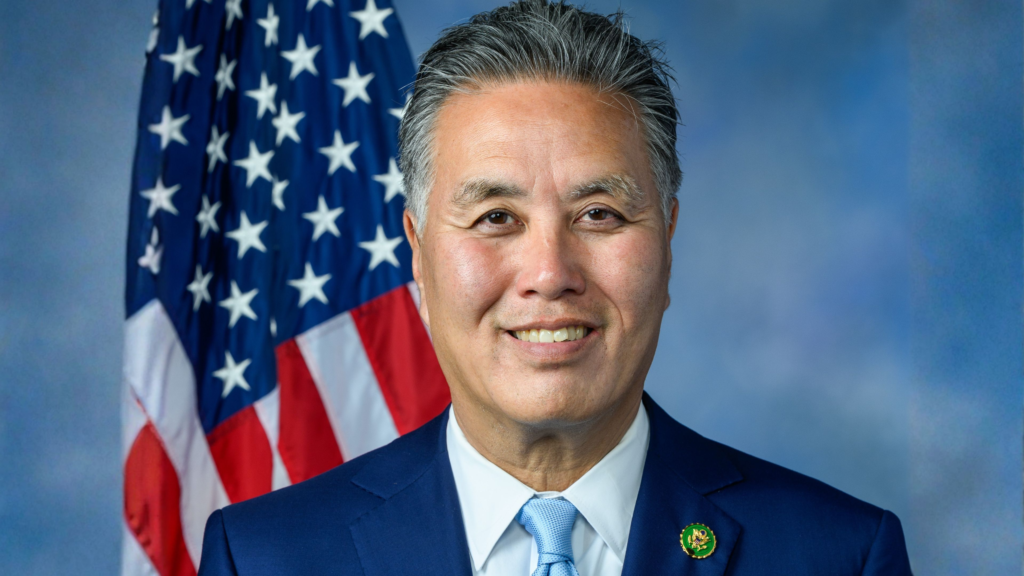
Mark Takano

Born in 1960, Mark Takano is also the descendent of a family that was subject to internment during the Second World War. After graduating university, he taught British literature for over two decades, before beginning a career in politics.
After contesting elections for nearly a decade, in 2012, Takano was elected as the US Representative for the 41st District of California, becoming the first openly gay Asian American to be elected to the House of Representatives. He is the co-chair of the Congressional LGBT Equality Caucus, as well as a member of the U.S.-Japan Caucus.
As a part of his work supporting LGBTQ+ rights, he has been particularly vocal in advocating for transgender rights in the US. He opposed an executive order banning transgender people from the military, and attended a retirement ceremony for those forced out of the service, apologizing for the way they were treated. He is also a strong supporter of abortion rights, and is considered a highly progressive Representative.
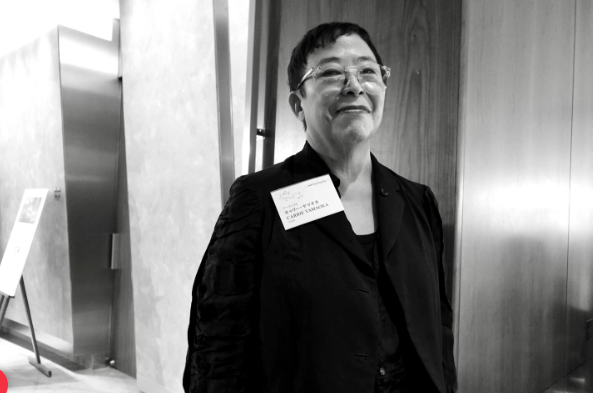
Carrie Yamaoka

Born in 1957, Carrie Yamaoka is a cross-disciplinary queer artist, based in New York. She works in sculputre, painting, photography, and drawing. One of her focuses are text-based pictures, often using old-fashioned typewriters. She also has a focus on erasure: when one looks at her work, one cannot but be struck by the usage of negative space.
Yamaoka is a queer artist, and in 1991 co-founded fierce pussy, a lesbian feminist art and activism collective. As a collective, the group speaks as a singular entity: when you are speaking to any member, you are speaking to fierce pussy. It engages in avant-garde art to address issue of lesbian visibility, and has been a consistent and persistent voice for LGBTQ+ rights for over thirty years, in no small part thanks to Yamaoka.
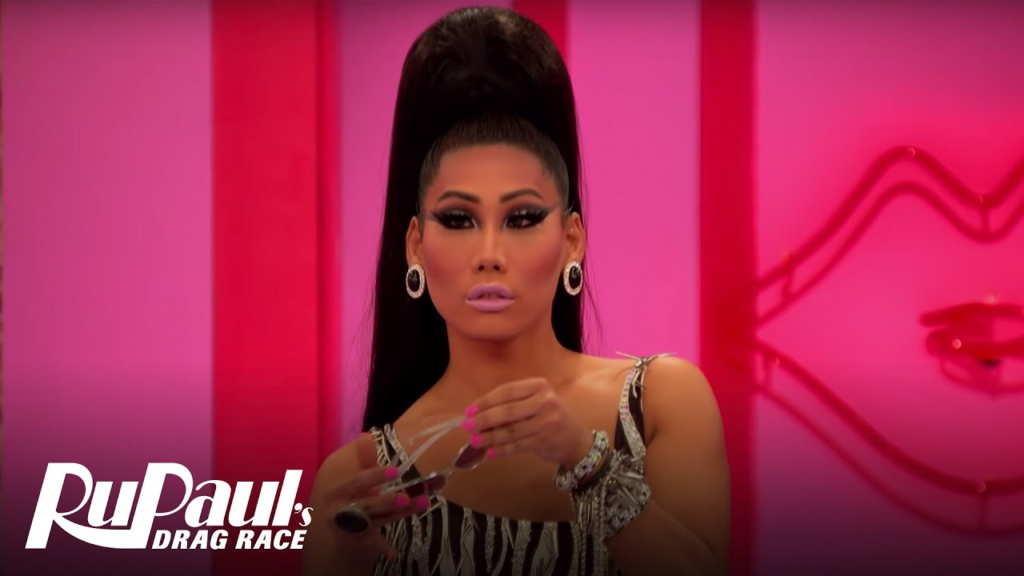
Gia Gunn

Gia Gunn is the stage name of drag queen Gia Keitaro Ichikawa, who was born in 1991 and raised in Illinois. From the age of five, she learned traditional Japanese dancing and acting, including performing as onnagata, which is to say, a man who portrays a woman in kabuki. As she grew, she took up drag, and won both the Miss Roscoe contest and Miss Diosa contest 2013.
In 2014, it was announced that she would join the sixth season of 鲁保罗的龙争虎斗, where she quickly gained a reputation for being stunning but vicious. Alas, she ended up being eliminated, and finished in tenth place. Nevertheless, she became a messy fan favorite, and returned on RuPaul’s Drag Race All Stars, the third transgender person to appear on the spin-off — where there was (allegedly) a confrontation between her and Ru Paul over the latter’s previous comments about transgender women.
She did, however, attract controversy in 2020 when she called Covid-19 a hoax. She apologized after significant backlash, and in 2021, was unfortunate enough to contract Covid-19 herself. Gia is amazing at serving face: but this time, it was to the leopards.
海莉-清子

Another 1991 baby, Hayley Kiyoko is a singer, actress, and novelist from Los Angeles. She is the daughter of Sarah Kawahara, a figures skater of Japanese descent, and Jamie Alcroft, who is himself an actor. She began her career in 2007, when she was a founder of the girl group The Stunners, and in 2009 she starred as Velma Dinkley in Scooby-Doo! The Mystery Begins.
Since then, she went on to release her first EP in 2013, and her first studio album, Expectations, in 2017, with her second, Panorama, released in 2022. In 2023, she was nominated for the GLAAD Media Outstanding Music Artist award, and embarked on a North American and European tour. As an actress, she has starred in Jem and the Holograms, and has also appeared on 鲁保罗的龙争虎斗.
She has said that she has known that she is a lesbian since she was six years old, and was inspired by Katy Perry’s “I Kissed a Girl” to use pop music to try to normalize lesbian relationships in a heteronormative world, and industry. Known by her fans as “lesbian Jesus,” she has also supported awareness of violence against transgender women in her song “One Bad Night” and its music video. She says of her work, “My motto is to help people love themselves sooner. I can’t teach them how to do that. They have to figure that out on their own.”
LGBTQ+ people of Japanese descent across the world have been making waves for years, decades, generations even. This is just a small list of some of the most visible, but doubtless there are many more, perhaps even friends of your own, who you can love and support.