


The expression, “art for art’s sake,” which became well known as a slogan in the late 19th and early 20th Centuries, has more recently been increasingly rejected by critics who are more focused on the inherently political nature of almost all artistic expression. It is no coincidence, then, that many of those who came of age during the 1980s — an era of deep political division masked under an aesthetic of inevitability — are openly political in their art, and activists in their lives more generally.
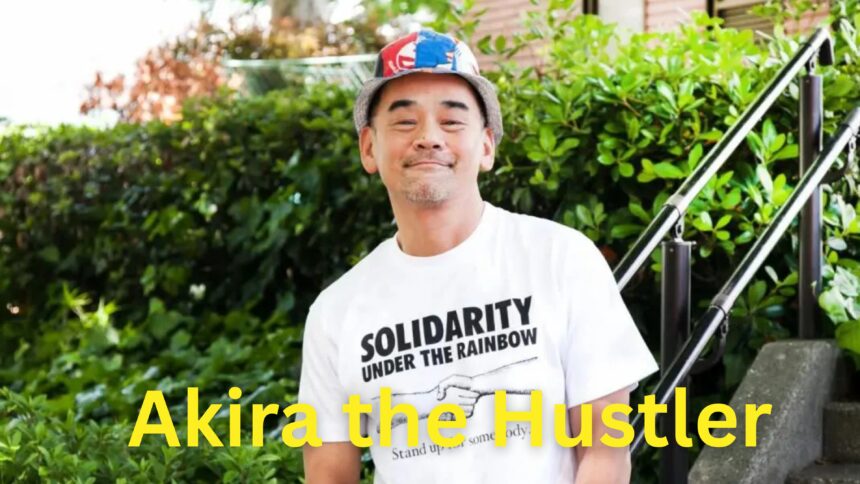
One such figure in the Japanese gay community is Akira the Hustler. A prominent artist, meeting with acclaim both in Japan and abroad, he has been active for decades, and was even a founder of one of the most iconic community spaces in Nichome. So, who is he? What is his background? And what is his work?
The Early Life of the Artist
Born Yukio Cho in Tokyo, in 1969, Akira lived in Germany for six years, from when he was two years old until he was eight. It was during this time that he first experienced discrimination. It was here, he says, that he learned of “the absurdity of discrimination.”
“In the early 1970s, and Asians [in Germany] were often discriminated against.There were Korean and Chinese kids in my elementary school, and we felt solidarity as Asians. From the Anglo-Saxon perspective, we were sometimes treated the same as each other because we were of East Asian ethnicity,” he told the Huffington Post.
“However, when I returned to Japan and started living in Kobe, my last name was Zhang, so I was called Korean or Chinese and bullied.” This ordeal proved to him how prejudice was not just cruel, but was utterly arbitrary.
After returning to Japan, he lived in Kobe, before attending the Kyoto City University of the Arts to study oil painting, where he earned an MFA. It was during this time that he became politically active, as one of his upperclassmen, who had contracted HIV, performed drag openly and proudly, while letting it be known that they were afflicted.
It was this experience that led him to realize that the prejudice felt by people who were, through no fault of their own, suffering from a disease that in many places was at best being ignored, and at worst being used to demonize the queer community (even in Japan, where a relatively hands-off “don’t ask, don’t tell” attitude existed — and to an extent, still does to this day).
He became a part of the AIDS Poster Project, which as a whole aimed to raise awareness of AIDS/HIV and instil among audiences sympathy for the sufferers, but which also helped him to express his anger at what was, ultimately, just another from of prejudice.
“Rather than the need to raise awareness, I was angry at the discriminatory social situation surrounding HIV,” he says. “It was anger against discrimination and prejudice, right? I wanted to commit to the prevention awareness and support necessary as part of the movement to eliminate discrimination.”
He went on to become one of the founders of Akta and was its director until 2011. Anyone familiar with Nichome will recognize Akta as one of the main
Re-entering the Art World
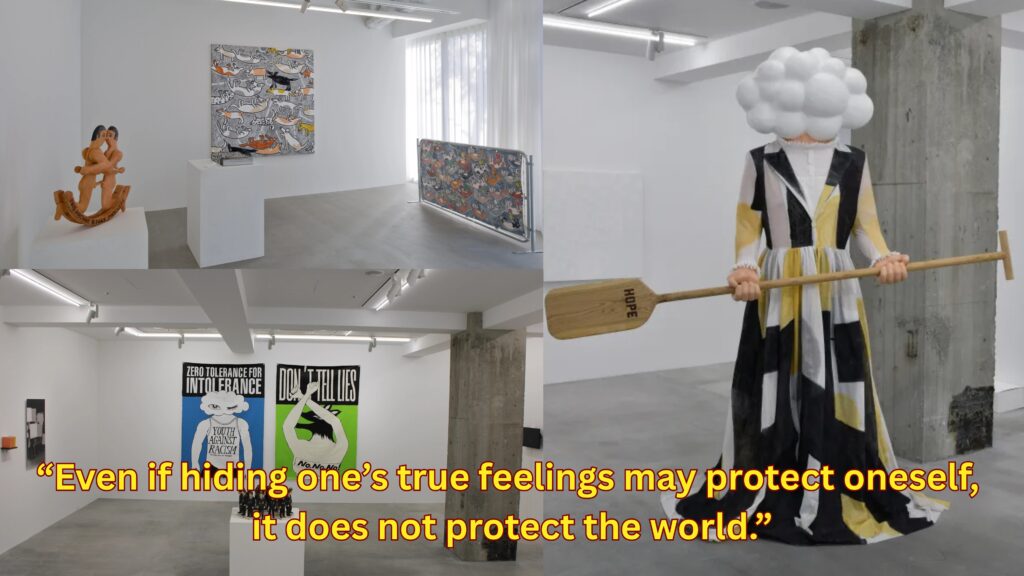
His passion for activism, though it temporarily delayed his larger artistic endeavors, served only to fuel the flame. At the turn of the millennium, he returned to art as a member of “Biters,” an art collective of sex workers (a profession that Akira turned his hand to: indeed, that is part of the reason he gave himself the nom de plume ‘Akira’). Their experiences informed their work, and their successes were celebrated by both the Watari Museum of Contemporary Art in Tokyo and the Beaux-Arts de Paris.
From there, he has flourished as an artist of many different forms. This included his first solo exhibition at the Ota Fine Arts Museum, where he explored what he experienced, and what he learned.
He has gone on to produce several exhibitions for the Ota Fine Arts Museum, incorporating painting, video, and photography, but also sculpture and performance. During this time, he continued to work in a gay bar, to be close to the community. But he told the Huffington Post that his drive to reunite his artistic prowess with activism continued to drive him. This was especially true as, in his role as a bartender, he would sometimes hear members of the LGBTQ+ youth make discriminatory remarks towards others.
Activism Never Ends
“Around that time, the number of gay people who made discriminatory remarks increased, and whenever I saw them, I started to feel like, ‘Have I really lived this life for people like these?’,” he said.
“The problem of discriminated people becoming discriminatory themselves is a huge issue worldwide. It may be due to their vulnerable souls or experiences, and it may also be an incredibly difficult problem to solve.”
This pushed him not only to continue with his art but also to become a writer to advance his activism. Additionally, in the wake of the 2011 Fukushima Daiichi Nuclear Plant disaster, he became outspoken in his views against nuclear energy. This was led by a number of people he followed on social media, and he soon discovered a strong mixture of not only gay and straight people, but of solidarity among a number of other causes, including women being imprisoned abroad.
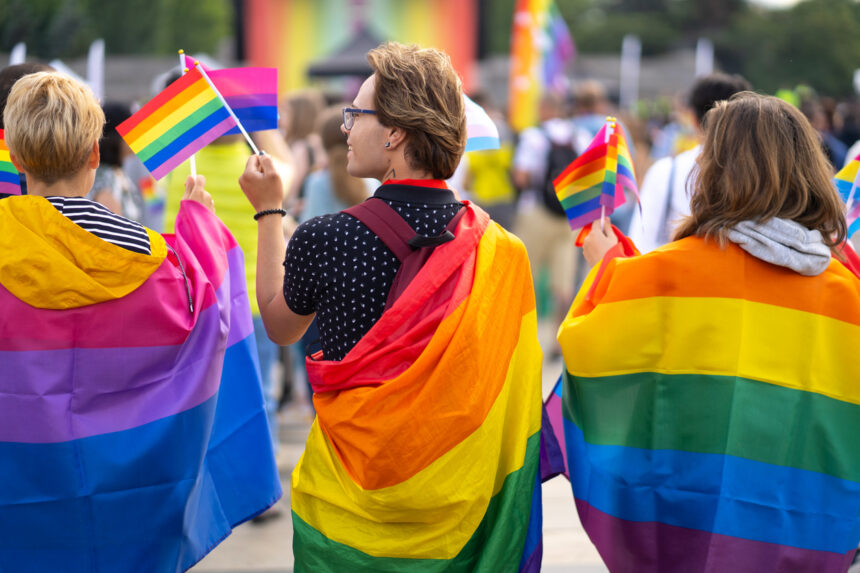
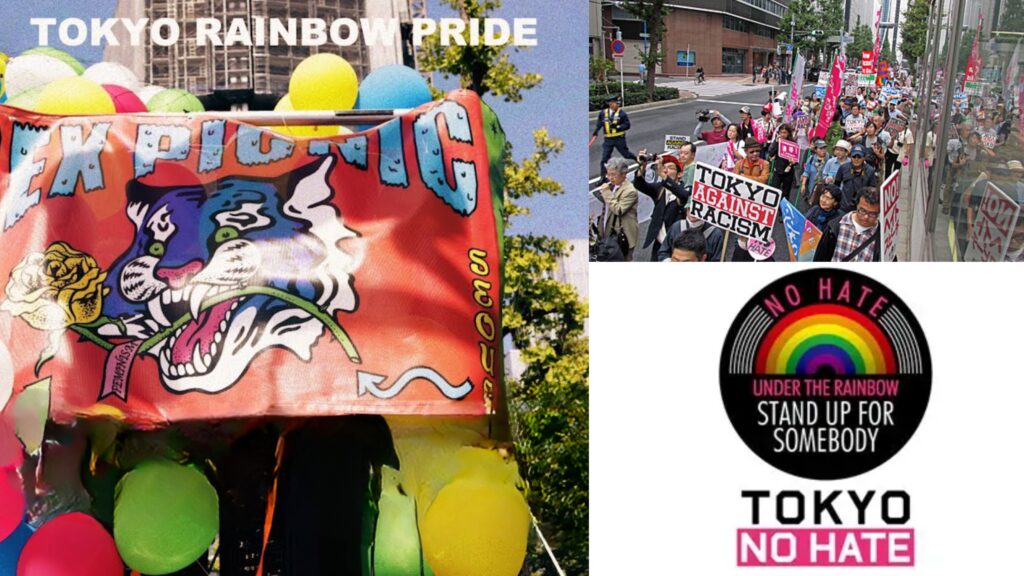
Becoming more and more vocal about political and social issues, both in his art and in his day-to-day activism and online presence, saw him asked by Tokyo Rainbow Pride to be a part of their drag queen float, under the banner: “TOKYO: NO HATE.”
“They told me, ‘You’re the only drag queen I could think of who would ride on it,” he said. Thinking that it might be meaningful, I accepted.”
Now, he is invested as an activist and an artist in a form of dedication that can be summed up in one word: solidarity. But he is more concerned with actions than words.
“Solidarity sounds like a big deal, but when you see someone in trouble, it just means thinking about what you can do to help. People say, ‘stand up for somebody.’ And if you trace it back to our roots, we were also “stand up for somebody,” he explains.
“I think it’s a chain reaction of people standing up for others. That’s all there is to it. It’s a very natural thing, isn’t it? ‘You helped me then, so I’ll help you next time.”
Solidarity is something that can be displayed in many ways, through marches, through writing, and through art. Akira the Hustler’s unification of these myriad forms of expression exemplifies, through his work, how solidarity works best: when everything — and everyone — works together.