




2026 has started with a bang for LGBTQ+ media! In addition to a new series of The Boyfriend, and an upcoming movie based on the life of Haruna Ai, we have a new lesbian movie on Netflix: Cosmic Princess Kaguya.
Based on the ancient Japanese legend of a princess from the moon who emerges from a cut piece of bamboo, this film has been anticipated for months. But is it a super moon, or are we suffering a lunar eclipse? Today, we’ll cut through the bamboo stalk for you and get to what’s inside, the good and the bad. Beware minor spoilers!
Premise

In the near future, student Iroha Sakayori lives alone in Tokyo, due to family issues. In addition to working to keep up her tuition and her living, she is known for being a star pupil and an extremely talented musician. However, she has a second-life, literally: she is a member of the online VR game Tsukuyomi, where she hangs out with her school friends and is a devoted fan of Vtuber idol Yachiyo.
One day, she comes across a baby in a utility pole, and compelled by her sense of responsibility, takes it home, where the baby grows almost overnight into a young girl, who says she is from the moon. Named Kaguya, after the mythical princess, the two share time together both in real life and in Tsukuyomi, where Yachiyo announces that the streamer who gets the most followers will win a collab with her.
Through the next few months, Iroha and Kaguya work together and get closer as they get closer to the collab, while facing a number of obstacles along the way, including popular fighting streamer group Black OnyX, and a looming threat against Kaguya. But as time ticks on, is their relationship still just that of streaming partners, or is it becoming more serious?
Moonlight or Moonblight?
In terms of quality, there is a lot that I enjoyed about this movie, but also a few things that hold me back from calling it a must-see. Firstly, Cosmic Princess Kaguya does an excellent job of drawing the viewer in from the very start. The confused and unreliable narrator is funny, as are Iroha making an “impure” wish for more money when she sees a shooting star, and then the refusal of the call as she repeatedly tries to close the door to baby Kaguya.
I also fully enjoyed the slightly chaotic energy of Kaguya, as contrasted with the serious yet enthusiastic persona of Kaguya. The entire film is filled with a youthful joie de vivre that is infectious.
Watching Iroha and Kaguya grow closer was also incredibly fun. We will understand later why Kaguya is so excited to live and work with Iroha, but along the way everything between the two is incredibly fun.
I did find, however, that the virtual world was, surprisingly, far less interesting than the real world. Additionally, there is a fighting tournament detour around halfway through the film that, for my money, takes far too long to conclude, and I started to lose interest. Additionally, while the fake-out ending is extremely funny, the over-long and incredibly convoluted actual ending overstayed its welcome.
Is Cosmic Princess Kaguya A GL?
Cosmic Princess Kaguya was not — and is not — promoted as a Girl Love (GL) anime. However, from the earliest trailers and released screenshots, many fans of lesbian media were asking the same question: “is this yuri?”
It is a valid question: is this really a yuri anime, or is it queerbaiting? Especially for a Netflix-released film, many people had concerns. However, after viewing it is very difficult to conclude that this is anything but a GL movie.
To begin, while Iroha is resistant to living and working with Kaguya (and who wouldn’t be confused and concerned about having adopted a baby who grows into a teenager overnight?), the gradual development of their relationship is very fun to behold, with little slips of Iroha’s increasing attraction to Kaguya (including accepting a secret handshake that ends with their fingers kissing) being extremely cute.
As the film progresses, it is utterly confirmed: Kaguya proposes to Iroha, and the two declare their love for one another. In an… interesting choice, it seems their love is in something of a VR-world prompted timeloop, which culminates in Iroha dedicating her career to building a body for Kaguya.
One issue that many fans of the genre will find disappointing, however, is that their relationship never develops beyond words of love, heads on shoulders, and longing. It feels like a build-up that is betrayed, and replaced with a very strange ending that, as mentioned, takes up too much time and is too meandering.
Sound and Animation
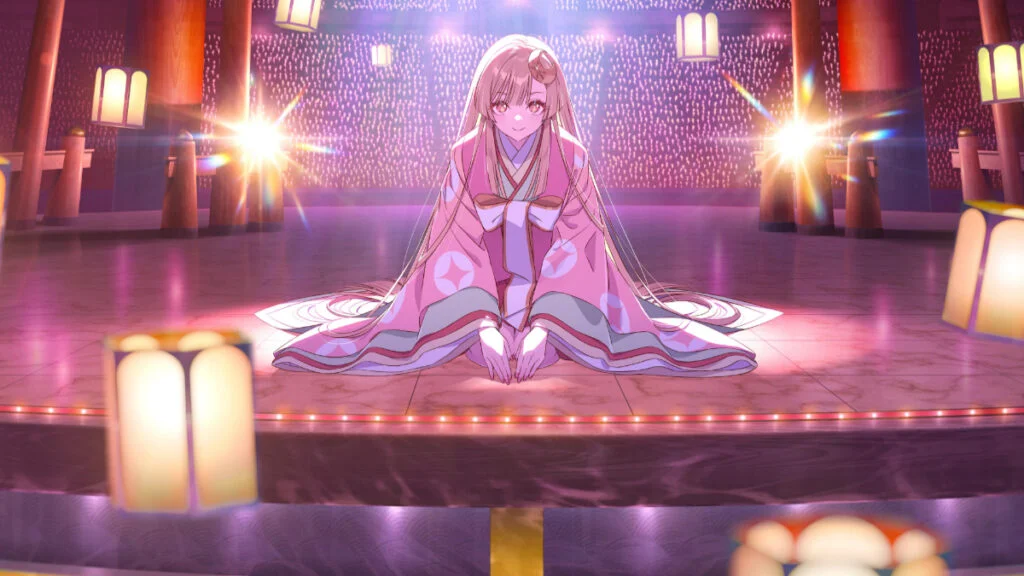
The music is very good. I suspect that this film will be compared, unfavorably, with K-Pop Demon Hunters, and the truth is that it does not match the quality of Sony’s movie. However, that is not to say that the music is bad by any stretch of the imagination, it is just far less varied and, in my view, doesn’t have any real killer tracks to keep you coming back in the vein of “This is What It Sounds Like” or “Golden.”
The animation is very good. It is, like the film, high energy, and even if I felt the fight scenes went on for too long, I still think the choreography and visuals of the combat were very good. The visuals were fluid, matched the film’s tone perfectly, and the musical scenes, while a little over the top, were impressive.
The voice acting was strong, with both the Japanese and English voice actors giving compelling performances. While unrelated to their work, I will say the English subtitles used a little too much Internet slang for my taste, and I fear that it will could seem dated in just five years.
Conclusion
Cosmic Princess Kaguya is not a bad film by any stretch of the imagination. However, it feels a bit unfocused in the middle, a bit messy at the end, and the yuri content is confirmed but not consummated. Worth a watch, for sure: but don’t necessarily put it at the top of your list.