
When one thinks of the word “fashion,” one’s mind immediately turns to the concept of clothing, styles, and either the look of an individual or that of an era or subculture. However, we must remember that “fashion” can also mean, “to create,” as in the sense of fashioning a tool. In some circumstances, however the two combine: one’s style is used as a tool not only to express one’s self, but also to create it.
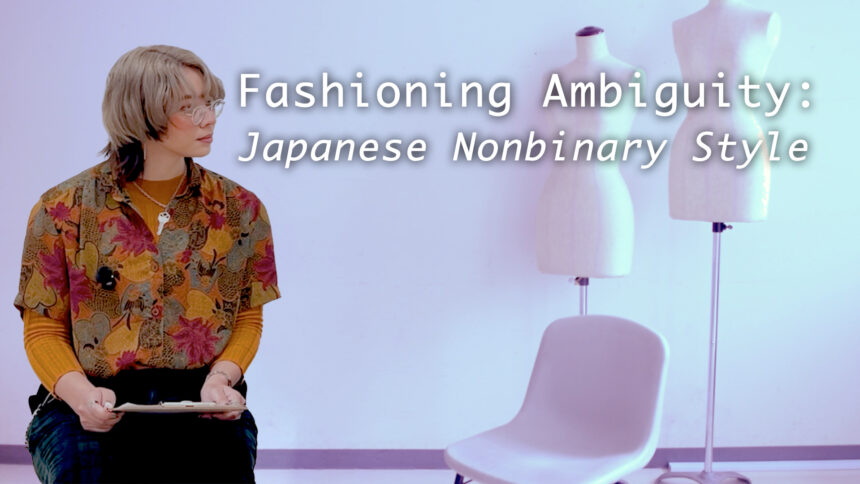
This can be especially true in the LGBTQ+ community, where clothing can be used not just as a way to communicate your identity to others, but also be a way to feel comfortable in your own skin. However, in a country like Japan, where people tend to be a little more reserved when it comes to sexuality and gender identity, to what extent does this remain the case? This is the subject of the short documentary Fashioning Ambiguity: Japanese Nonbinary Style by nonbinary creator Abe Lee.
Synopsis
Lee, who is a Master’s student at Bunka Fashion Graduate University (famed for designer alumni such as Yohji Yamamoto and Kenzo Takeda), created the documentary to help explore and interrogate not only how nonbinary gender is expressed through fashion in Japan, but also how the expression can differ from that of the west, and what that means for both Japanese and non-Japanese people living here.
Throughout the documentary, they draw not only on their extensive research of academic materials — as one would expect of a graduate student — but also interview a number of prominent people in Japan’s nonbinary community. The community is at present small, but, as the documentary goes on to show, it is growing, in both number and in strength. They intended not only to educate viewers on the nuances, challenges, and joys of gender-non-conforming life in Japan, but also to inspire the young and the young at heart to live authentically.
Along the way, they speak to academics such as SPF Dale, a former adjunct assistant professor at Hitotsubashi University whose doctorate thesis explored how nonbinary gender identities are constructed in a Japanese context, as well as and Kyoko Takeuchi, a professor at Kwansei Gakuin University, in Hyogo, whose work on nonbinary people in Japan is considered by some to be The Book on the subject.
They also spoke to Andromeda, one of the founders of Iwakan magazine, which is focused not only on nonbinary issues and fashion, but is open to and produced for anyone unsatisfied with Japan’s status quo (from a progressive perspective, of course). They also meet with Kelly and Megumi Williams, the owners of Black Bird Eatery, a queer-friendly cafe, and Q-Chan, a Kansai-based nonbinary fashionista.
Japan vs. The World: Nonbinary Difficulties
It might seem counter-intuitive to think of a dichotomy when it comes to nonbinary identities, but to be clear, the documentary points out how being nonbinary (and indeed, being queer in general) can be different in Japan, as opposed to the rest of the world.
“I do think it’s easier to find community abroad,” says Andromeda. “People are more open about their sexuality, whereas in Japan, people are much more conservative about their personal lives, although this is changing thanks to social media. People in Japan are more used to code-switching. That builds your personality in a different way.”
Andromeda notes that, as a result of this relative conservatism people who are nonbinary in Japan are less likely to be subject to physical violence than they may be in other countries, but that this comes with its own specific drawbacks.
“You’re much less likely to be stabbed,” Andromeda says. “But in some ways, being queer in Japan can be a lonelier way of suffering.”
Additionally, Dale, who can be considered one of the first experts to specifically study nonbinary/gender non conforming people in Japan, as well as queer expression, was unaware of the Japanese concept of “X-gender” before doing research into transgenderism and androgyny in Japan for their PhD thesis. The term was, in their experience, limited to Japan, and so despite the growing unity among gender non-conforming people, especially as social media becomes an ever-increasing part of people’s lives, there are still some issues that have yet to be resolved.
Takeuchi and Lee’s discussion brings up the fact that there are even some issues in communication among nonbinary people. This is not only because, in Japanese, using pronouns is not nearly as common as it is in western languages, such as English, but also that the terms used for nonbinary expression can be different depending on generations and geography, which can lead to people who share similar identities being separated by what Lee calls “the stickiness of terms.”
For example, people in the Kansai region — whose major cities include the beloved Osaka, Kobe, and Kyoto — tend to use the expression “x-gender,” which originated in this area, while those in the Tokyo-dominated Kanto region tend to use the English loan word “nonbinary.” This can also be a problem between generations, where those who are older are describing phenomena that is common to all nonbinary people, but using language that might be alienating to their younger cohorts.
Building Bridges
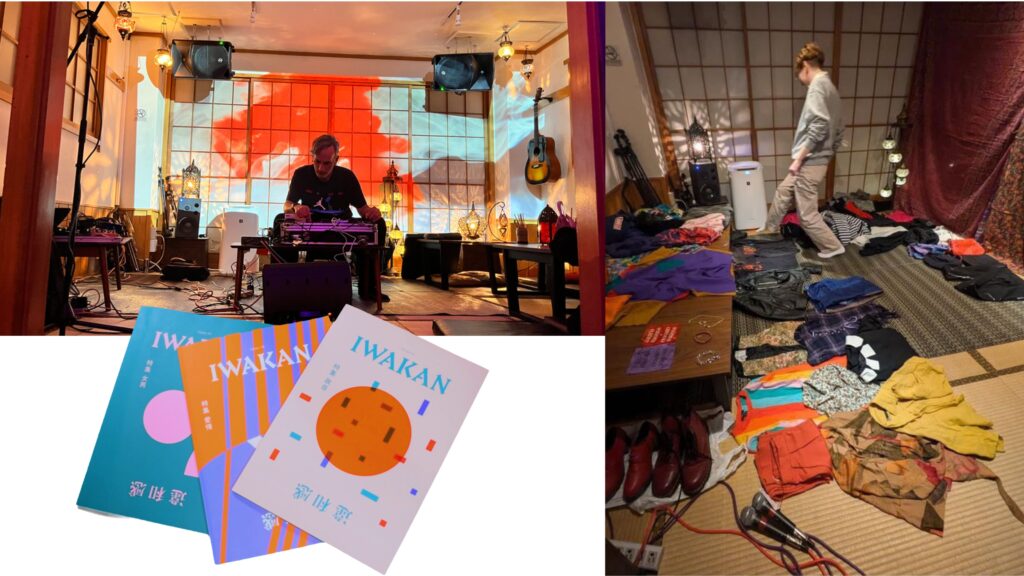
Despite these difficulties, nonbinary people in Japan are working — and succeeding — at building communities for and with one another. For example, the aforementioned Iwakan magazine is so-named as it is a direct translation of “dysphoria.” It is not just a publication for news or activism (though those are deeply important), but, in the words of its founders: “Through art, culture, design, and our community, we hope to spark a change in the way society thinks about gender.”
Additionally, Black Bird Eatery, in Shibuya, Tokyo, is owned and operated by two gender non-conforming partners, who — in addition to creating a space that is queer-friendly and (unlike many LGBTQ+ spaces in Tokyo) not exclusively focused on consumption of alcohol, hold events to promote queer life in Japan. This includes evenings for creatives to show off their work, but also clothing exchanges.
While clothing exchanges may seem, on the outside, to be an efficient way to trade clothes (or empty out an overstuffed wardrobe), it also provides an essential safe space for those who are exploring or coming into their gender identity. For people who might otherwise be too shy to wear the clothes that they want, they not only have a place to express themselves through fashion, but can do so in a supportive environment with like-minded people.
Another thing that the documentary highlights is that just as clothing fashion has its own way of making people feel comfortable with themselves, so too do terms that come into style. As Q-Chan says: “Nothing in my style has changed, but now I can use the term ‘nonbinary’ to [accurately] describe myself.”
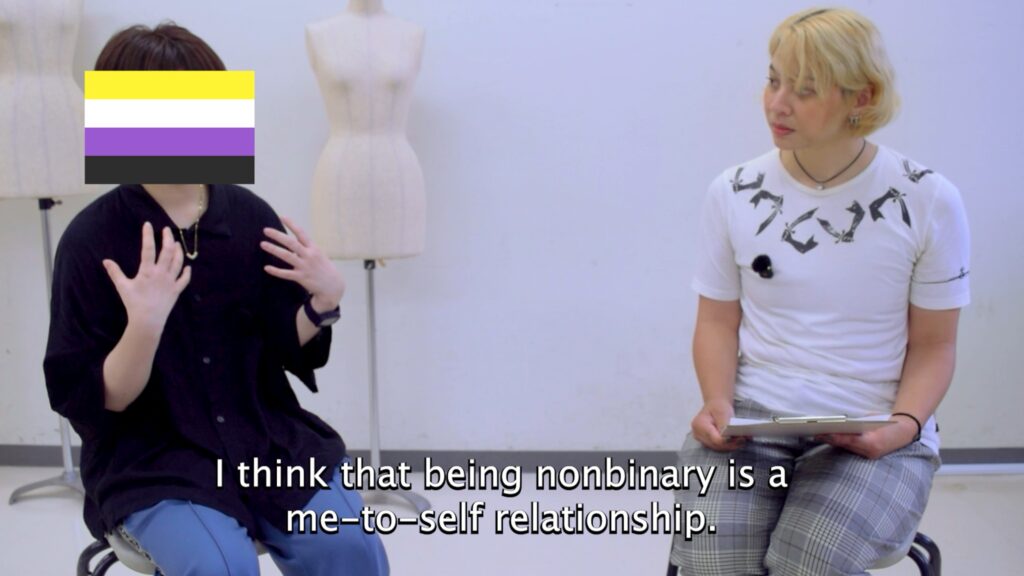
Nonbinary fashion, and fashioning one’s own nonbinary identity, Lee concludes, is about creating an identity that makes you feel comfortable within yourself; balancing the different aspects of your personality and gender instinct, whether feminine, masculine, and all or none of the above, while accepting — and embracing — the ongoing challenge of defining and creating yourself. No matter who you are, where you’re from, or when you were born, Japanese nonbinary fashion makes it clear that self-actualization never goes out of style.