

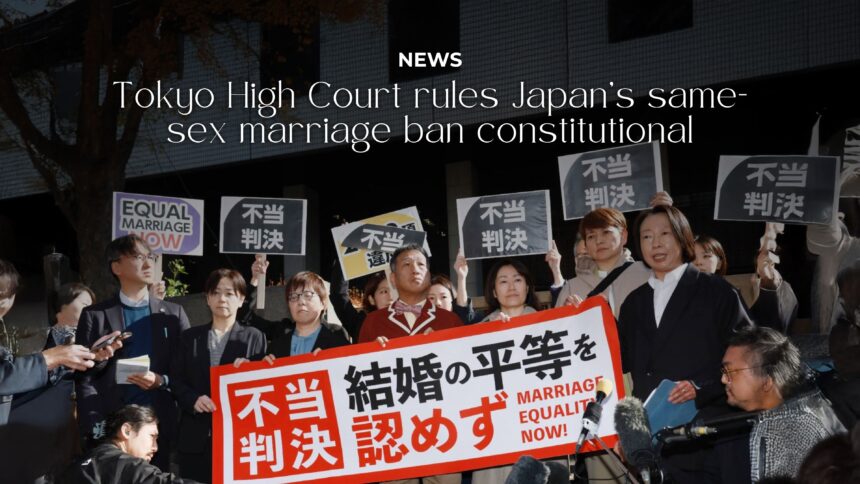

At the end of November 2025, the movement for marriage equality in Japan suffered a significant setback, as the Tokyo High Court has issued a new ruling that contradicts its own position from just a little over one year ago.
What does this new ruling mean, why was it decided the way it was, and what comes next? This brief explainer should help you with everything you need to know.
Background to the Ruling
Part of the reason that the ruling of 28 November came as a surprise to many is that, over the past few years, in addition to growing public support for marriage equality, there have been a number of District Court and High Court rulings in Japan that have affirmed that Article 24 of the Japanese Constitution, which defines marriage as a union between one man and one woman, are in violation of Article 14, which guarantees equality.
We have a more detailed article about the recent history of these decisions here. In short, given the multiple affirmative decisions given by High Courts across Japan over the past few years, this ruling was not expected to be significantly different. Regrettably, this turned out not to the the case.
Judicial Decision
This case was filed in order to appeal the decision of the Tokyo District Court not to award financial damages, despite the ruling from the District Court and a previous affirmation from the Tokyo High Court that the plaintiffs’ rights had been violated. However, Presiding Judge Ayumi Higashi handed down a ruling not only denying damages, but also reversing the Court’s previous decision that the lack of marriage equality is unconstitutional, and violates plaintiffs’ civil rights.
The ruling instead said that Article 24, which guarantees the right of marriage, does not apply to same-gender couples. So, why did she come to this conclusion?
Reasoning
The reasoning behind the decision is, in the opinion of your humble writer and by many of those who have read it, seems convoluted and highly unusual.
- Children and the State
Firstly, one of the main reasons given is that: most children in Japan are born from married, heterosexual partners, and also that, as the constitution is designed to protect society, it is in the state’s interest to create an environment where more children are born. As most children are born to married people, it is assumed that this is the most effective way to protect society and the state, and that LGBTQ+ people do not lose protections by not being permitted to marry.
This is absurd on the face of it: while it might be true that the vast majority of children are born to married couples, Japan’s birth rate has been falling for decades, so clearly if heterosexual-only marriage is designed to promote childbirth, it is failing. Nor is it apparent how forbidding queer people from getting married to the partner of their choice would somehow render straight married couples infertile.
- Contracts and Gender Transition
One of the more bizarre aspects of the judgement is the assertion that “part of the effects of marriage can be substituted by contracts.” While this isn’t necessarily untrue, given partnership agreements offered across Japan, “part of the effects [being] substituted” necessarily implies that some effects are not and cannot be substituted — an obvious violation of a right to equality on its face.
However, this is accounted for by noting that, should one desire, one may change their legal gender, and therefore an LGBTQ+ person may marry the partner they want to through transitioning. Aside from the preposterous suggestion that transitioning in Japan is a simple matter, it is obviously the case that not all queer people want to transition, and amounts to a clear violation of personal freedom.
- Deferring to the Diet
A third line of reasoning is that, ultimately, if this was such a major problem, the government and parliament would have already dealt with it, and so since it hasn’t been dealt with, it must follow that it cannot be a major problem.
On the other hand, this is contradicted immediately by the admission that the Diet is intentionally delaying and stalling on making any decision, which Judge Higashi acknowledged could result in the violation of civil rights of LGBTQ+ people. So the decision is that there is no problem, since if there was, the Diet would do something about it, but if the government continues to do nothing, there may be a problem at some unspecified point in the future.
Reactions
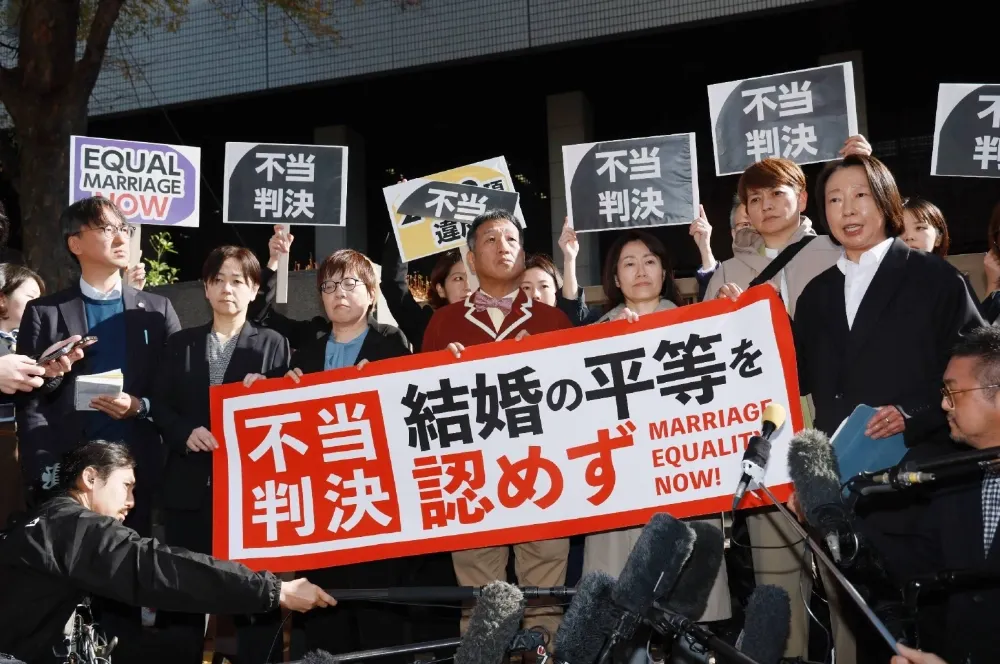
As one can imagine, the reactions to this ruling were shock and anger from many. The plaintiffs and lawyers held a banner protesting the ruling. Those in the assembled people who came to witness the ruling felt upset and betrayed.
Those who are married abroad, but whose marriage is not recognized here, not only pointed out how this is a denial of their reality, but also that if they have children, who are considered by the Japanese government to have been born “out of wedlock,” their rights to their children — and the rights of the children themselves — are violated.
Even some who agreed in principle with the ruling were taken aback. Twitter user MH, who is a devout Christian, said that while they did believe that marriage equality is unconstitutional, they were “truly astonished by such a hideous interpretation of the law” and found it unacceptable as a lawyer.
What Happens Next?

The plaintiffs have made it clear that they are not going to give up, and that this ruling will be appealed to the Supreme Court of Japan. Given the importance and now inconsistent rulings among Japan’s High Courts — though the majority agree that Article 24 is unconstitutional — it is widely anticipated that the Supreme Court will hear the appeal. What its ruling will be, however, is far from certain, especially given this shock.
Despite this shock setback, support for marriage equality in Japan remains the majority opinion of the public. We don’t want to give false reassurances, as the Supreme Court of Japan, if it hears the appeal, may have a similar conclusion (if not necessarily similar reasoning). However, the fighting isn’t done yet, and the majority of the people in Japan is on the side of LGBTQ+ folks who only want their basic rights.