


Before moving to Japan, I did the most gay thing possible: I made a Twitter/X profile. At the time, I was learning Japanese and wanted a space to write and practice my Japanese and conversation skills. I could make grammatical mistakes, post selfies, and try to find some friends before moving, and also farm likes to feed my ego. And, of course, it goes without saying that I wanted to talk to hot Japanese guys, of whom I was lucky to find many.
But what I also found on guys’ profiles was what looked like a random string of codes in their bios. On the UK and US side of X, I had never seen this before and couldn’t understand what it meant or why it was there. Also, sometimes I would even see a vanilla ice cream emoji, or even an ant emoji. Maybe these people were into something freaky? Maybe they were showing off their favourite food or animal? As much as I researched what it could all mean, I couldn’t find an answer until I got talking to someone and had to ask the awkward question of what it actually meant.
And so, being a good gay, I have decided not to gatekeep and instead share with you what all of these cryptic codes and symbols actually mean on a Japanese gay Twitter/X profile bio.
How to Read a Japanese Gay X/Twitter Bio
Before looking at individual terms, it helps to see how they can work together.
Consider this fictional but realistic example:
170/70/35 G リバ GMPD
Read from left to right, the profile contains four different types of information:
- 170/70/35 – basic physical details (someone’s height, weight, and age)
- G – a sexual identity label
- リバ (riba) – sexual role
- GMPD – body-type or community shorthand
The first three numbers are usually the easiest place to start. In this format, they indicate height, weight, and age. G can be used as shorthand for gay, while リバ (riba) indicates someone who may top or bottom. GMPD is more complicated and can carry different meanings depending on context, which we will explore later.
Real profiles do not have to follow this order. Someone might put their role first, leave out their age, or add information about their preferences or relationship status. The important thing is that these pieces of information do different jobs. Some describe the person. Others describe who they are interested in, their relationship status, or what they are looking for at that moment.
Quick-reference Table
| Shorthand or notation | Approximate meaning | What it communicates | Important context |
|---|---|---|---|
| 170/70/35 | Height/weight/age | Basic profile information | Usually centimetres, kilograms and age |
| G/B | Gay/bisexual | Sexual identity | Read in the context of a self-description |
| タチ/凸 | Tachi/inserting role | Sexual role | Does not describe personality or appearance |
| ネコ/ウケ/凹 | Neko or uke/receptive role | Sexual role | Neko and uke can both appear in profile shorthand |
| リバ/回 | Riba/versatile | Sexual role | Indicates someone who may take either role |
| 🍦/バニラ | Vanilla/side | Sexual role | Indicates someone with a sexual preference or position that does not involve anal penetration |
| GMPD | A group of Japanese gay body-type labels | Body type, preference or community context | Meaning depends on how it is used |
| ○○専 | Especially interested in a particular type | Preference | As an example, デブ専 (debu sen)means a preference for larger men |
| mrmr | ムラムラ (sexually aroused or in the mood) | Current state or immediate intent | Often more temporary than fixed profile information |
| 🐜 | あり (’has’ or ‘with’) | Relationship status in some contexts | Current gay-profile sources document it for 彼氏あり (kareshi ari), meaning ‘has a boyfriend’ |
When reading a profile, ask a simple question about each term: what kind of information is this communicating? Is it describing the person? Their identity? Their sexual role? Their type? Or their current situation?
That makes even a very short profile much easier to read.
The Numbers and Letters in Japanese Gay Profiles

The numbers in a Japanese gay profile are often the easiest part to decode.
A format such as 170/70/35 usually means:
- 170 – height in centimetres
- 70 – weight in kilograms
- 35 – age
The separators can vary, and some users may add spaces or use different punctuation. However, the basic height/weight/age format has a long history in Japanese gay online profiles and still appears in current profile examples.
You may also see a letter such as G or B alongside these numbers. When used as part of a self-description, G generally means gay, while B means bisexual.
The shorthand that follows may tell you something quite different, such as sexual role, body type or preference.
Tachi, Neko, Riba, 凸, 凹, and 回
Once the basic numbers and identity markers are clear, the next part of a profile may communicate sexual role.
The three terms you are most likely to encounter are タチ (tachi), ネコ (neko), and リバ (riba).
At their simplest:
- タチ (tachi) refers to the penetrating role
- ネコ (neko) refers to the receptive role
- リバ (riba) refers to someone who may take either role
You may also see ウケ (uke) used for the receptive role, or セメ (seme) for penetrative. These terms can be written out in full, but symbols can also be used as shorthand:
- 凸 = tachi (or seme)
- 凹 = neko (or uke)
- 回 = riba
These labels describe sexual role. They do not automatically tell you anything about someone’s personality, masculinity, femininity, or appearance.
A profile may place height, body type and sexual role beside one another even though each describes something different.
For a deeper explanation of tachi, neko and riba in Japan, see our dedicated guide. If you are also confused by related terms such as seme and uke, our guide to seme and uke in BL and real life explains how those terms overlap and differ.

🍦 and バニラ
The vanilla ice cream emoji is sometimes used as visual shorthand for バニラ (vanilla), a term used in Japanese gay slang. In this context, ‘vanilla’ generally refers to sexual activity without anal sex, such as kissing, touching, or oral sex. The term comes from the idea of vanilla being a plain or conventional flavour. In sexual slang, it came to describe ‘conventional’ sex or sex without more unusual/kinky elements.
The emoji comes from the simple association between vanilla ice cream and the word バニラ. It can be a discreet way to refer to this preference without spelling it out directly. Among English-speaking gays, the term ‘side’ may also be used to describe the same thing.
GMPD, 専, mrmr and Other Profile Shorthand
Not every piece of shorthand in a profile describes the account holder directly. This is particularly important when reading body-type labels, preferences, and status markers.
GMPD
GMPD is informal shorthand that groups together several body-type labels used in Japanese gay culture. It is not simply another measurement like height or weight.
Depending on how it appears, it can relate to self-description, attraction, or a wider community context. That means GMPD should not automatically be treated as a simple physical description of the person whose profile you are reading.
For the full explanation, see our guide to what GMPD means in Japanese gay culture.
○○専: A Preference, Not Necessarily a Description
The character 専 (せん/sen) appears in terms that describe a particular preference. For example, デブ専 (debu-sen) means someone who is especially interested in larger or heavier men.
The important decoding rule is simple: 専 tells you what someone prefers. It does not necessarily describe what they look like themselves.
This is an easy mistake to make in a short profile, where body-related terms can sit right beside someone’s own physical details.
mrmr
No, these people aren’t cold and using this as slang to explain it… brr.
You may also see mrmr, a shorthand form of ムラムラ (mura mura). This is Japanese onomatopoeia that indicates sexual arousal, desire, or being ‘in the mood’.
Unlike height or age, this is more likely to describe an immediate state. It may appear in a profile, post, or status when that feeling is relevant at the time rather than as a permanent description of the person.
🐜
This one particularly confused me when I was starting to explore my newly-made Japanese gay X profile. I couldn’t think of a reasonable explanation for this and settled for possibly a profile ‘lurker,’ or someone who doesn’t interact with people but looks around X to see what people are talking about or up to.
The real meaning is that the ant emoji, 🐜, can also appear as shorthand for あり(ari), meaning roughly ‘has’ or ‘with’. This is because the word for ‘ant’ in Japanese is a homophone: ‘ari.’ In current Japanese gay-profile examples, one documented use is 彼氏あり (kareshi ari), meaning ‘has a boyfriend.’
However, the emoji should not be interpreted in isolation. As with other shorthand, the surrounding profile gives you the best clue about what the user means.
The broader pattern is worth remembering: some terms describe the person, while others describe the people they prefer, their relationship status, or what they are looking for right now.
That difference becomes even more important when moving between X and dating apps, where the same shorthand may serve slightly different purposes.
What Changes Between X and Dating Apps
The same shorthand can appear across X, dating apps, and other Japanese gay online spaces. However, where a term appears can affect what it is communicating.
Height, weight, age, and sexual role are often more permanent profile details.
Other terms can be temporary. For example, mrmr can communicate an immediate state of sexual desire or arousal, so someone may use it in a post, status, or profile only when it is relevant.
Conventions can cross between social media and dating apps, but their frequency and context vary. The most useful rule is to look at both the term and where it appears.
A Note on H-Number Profiles
Profile shorthand also changes over time.
A 2015 study of young gay men using Twitter in Japan documented an older form of profile notation beginning with H, followed by a number. The “H” refers to the Heisei era, while the number indicates someone’s birth year within that era.
For example, H5 meant someone born in Heisei 5. You may also come across the odd silver fox on X with an S on their profile bio, which indicates that they were born during the Showa era.
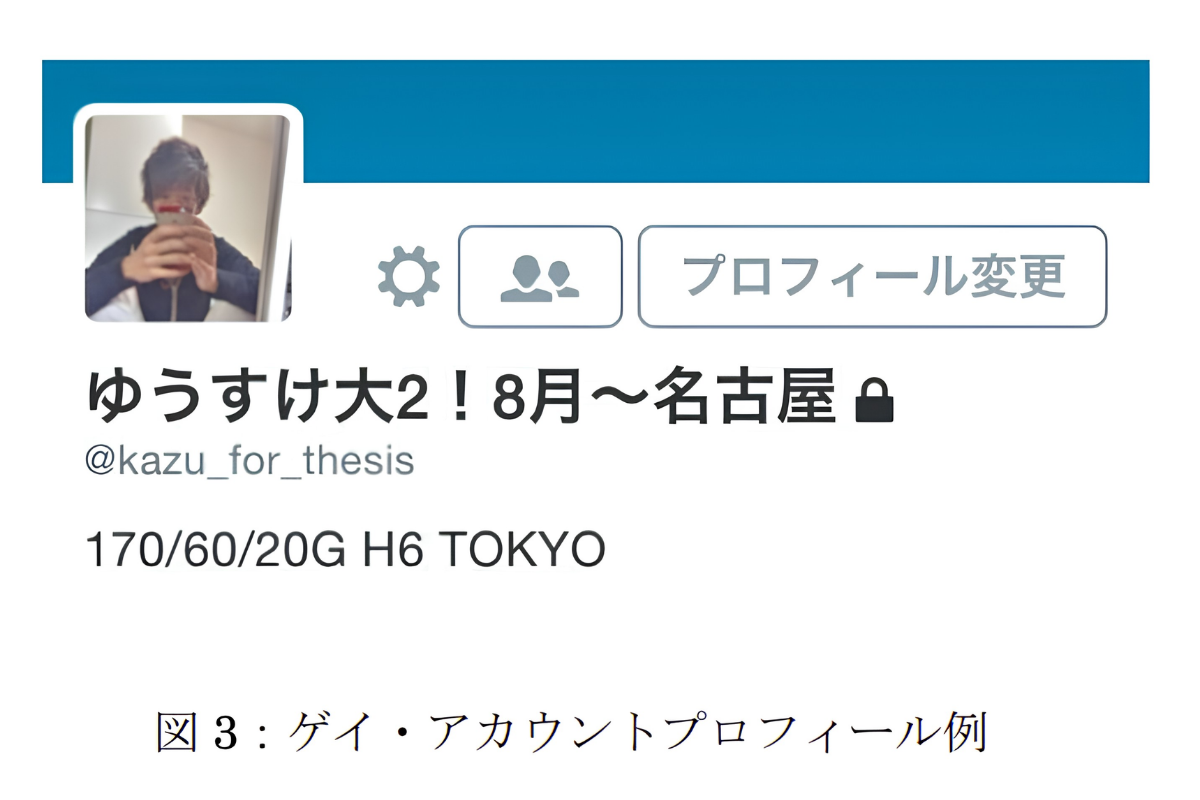
This convention comes from research, so it should not automatically be treated as standard in 2026. More broadly, an unfamiliar code may be current, outdated, or specific to a particular online community.
If you are looking for a platform rather than trying to decode its users, see our guide to the gay dating apps used in Japan.
Read the Profile, Not the Person
Japanese gay profile shorthand can fit a large amount of information into a very small space. But it’s important to remember what these codes can and cannot tell you.
They can help you understand information that someone has chosen to put in their profile. They are not a reliable way to assign an identity or label to someone else.
Before interpreting what a term means, look at the surrounding profile. Does it appear to describe the person, the people they prefer, their relationship status, or what they are looking for at that moment?
And there we have it: your guide to all-things-Japanese-gay X profiles. While your imagination of what some of these cryptic codes and emojis could have meant may have been far more entertaining, I hope this has helped remove the mystery. And now with this information, you can act like a Japanese gay X profesh and get talking to those hot gays.
And if further guidance is needed on other slang terms, our guides to Japanese gay and BL slang and other LGBTQ+ terminology can help you explore things in more detail.