

What is it like to be possessed with a singular talent, one that can take you from poverty to prominence? And then what is it like for that talent to turn out to be a curse, born of a tragic accident? Finally, what if you meet with the only other survivor, you fall in love… and now that your thoughts are consumed with him, what is it like to want to write about him, knowing that it could cost him his life?
This is the premise of Sleeping on Paper Boats, a Boys’ Love period piece about a screenwriter wracked with both survivor’s guilt and desire, and the man who could be his salvation… if he can escape his curse.
Premise
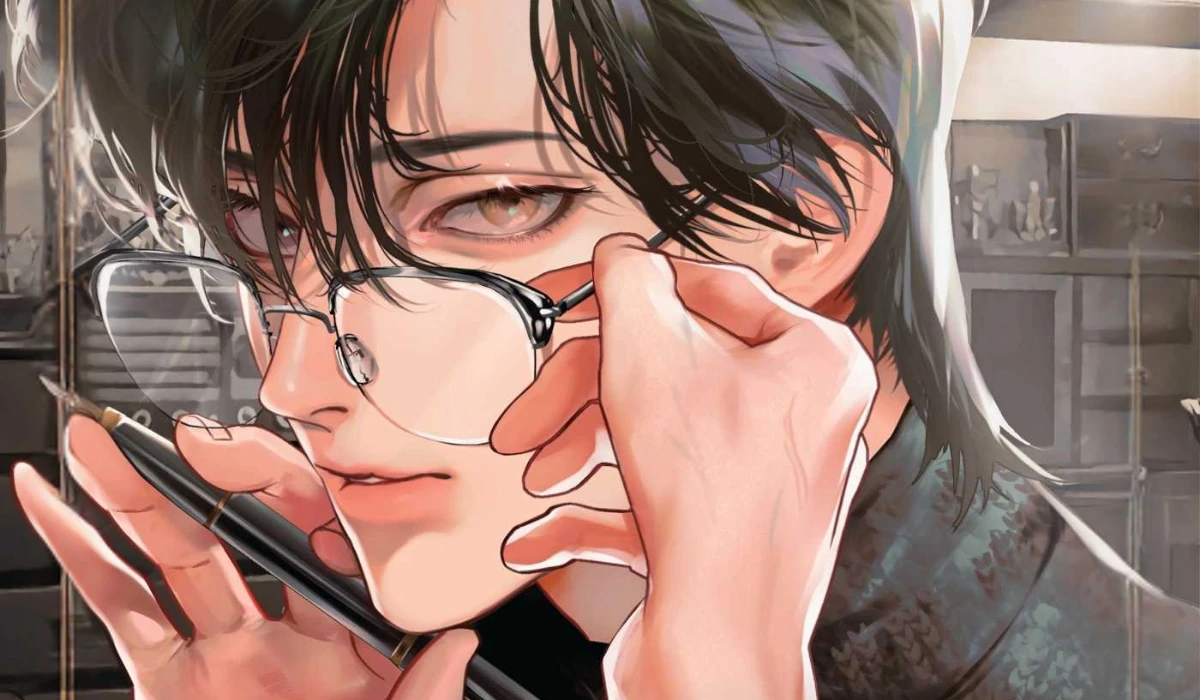
Created by Teki Yatsuda, Sleeping on Paper Boats’ prologue begins in 1940s Yokohama, where main character Kei Kitahara is a passenger on a tramline, and is suddenly taken aback by the sight of the face of a beautiful boy sitting opposite. Suddenly, the tram collides with a US military truck, and Kei awakes amid chaos — and corpses. He beholds a Shinigami (a spirit of death, akin to the Grim Reaper)… and we are shot to the present, over a decade later.
Just as Japanese cinema is going through a renaissance, Kei has become a famous screenwriter, with all of his scripts going on to become hit films. However, he hasn’t written for a long time: his works are based on people he knows, and soon after his films are released to critical acclaim… the people whose lives he has adapted die. Now, he has become something of a lost soul, drowning his sorrows (and his guilt) in local bars.
One night, after being beaten up by some American soldiers, he is pitied by a handsome man who takes him to his inn for the night, to rest and recover. This inn turns out to be a place where all sorts of folk can enjoy all sorts of pleasures. Soon, he discovers that the owner, Mikami Youichi, is the beautiful boy he saw on the tram — and the only other survivor. Inspired by his beauty, he becomes compelled to write about him… but can the curse be lifted? Or will the misfortune continue?
Going Off Script?
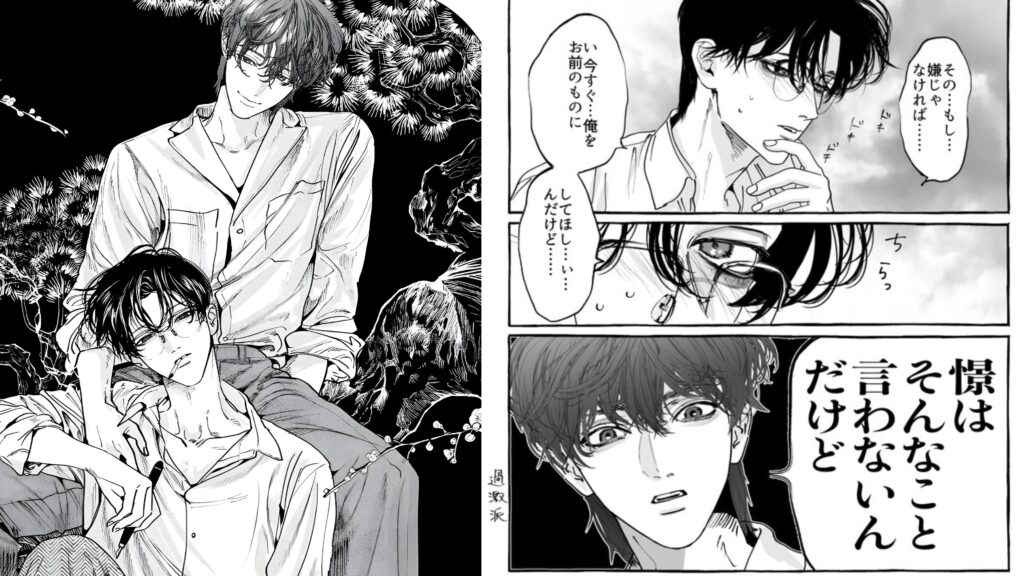
Kei is instantly likeable as a talented but tormented artist — a well-worn archetype, but one here that is more than ably portrayed. An interesting inversion to the typical stereotype, however, is that rather than being impoverished and suffering for his art, as mentioned above, he is instead deliberately limiting himself, because the power of the Shinigami is harming those around him with every success.
His seriousness is well contrasted with Youichi — who is a hobbyist photographer, as well as innkeeper — in that the latter is far more light-hearted, and his kind nature helps Kei to slowly but surely lose his dependence on drink to numb his pain… but at the same time, this brings back his urge to write, just as he is commissioned for a new screenplay. His newfound passion for Youichi, however, appears to let him shake off the Shinigami. Or is it that the Shinigami, like a script being turned into a film, has merely changed forms?
Thoughts and Feelings
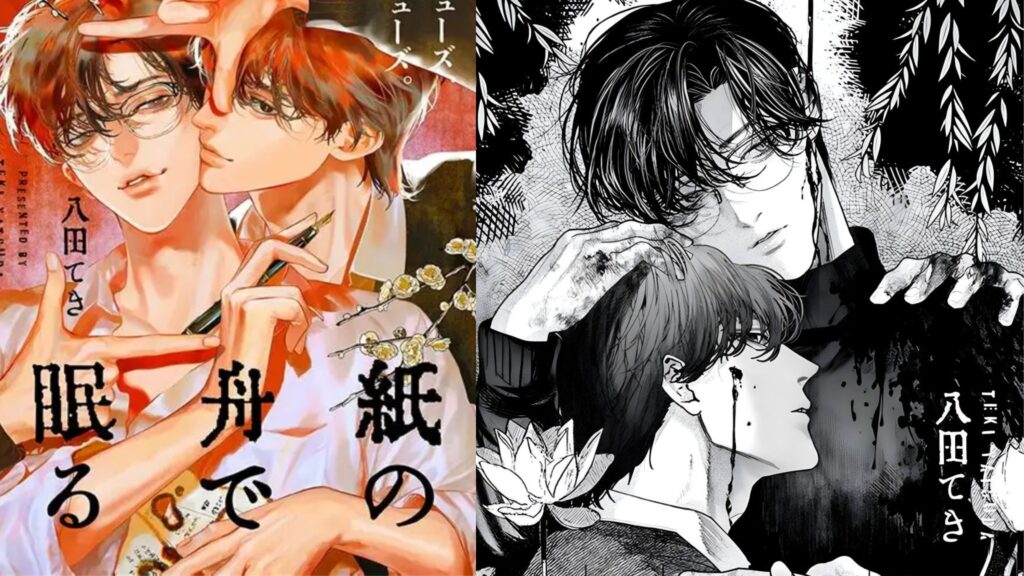
This is an incredible first volume. The artwork is extraordinary, although I did giggle a little when the Shinigami seemed to appear in the form of Sans Undertale. I really enjoyed the way the closeness between the two not only makes them happy, but also reveals a little more complexity in their relationship: as Kei returns to public life, Youichi begins to feel a little alienated.
The tension between the two and their differing lives, as well as what their relationship means for them personally and professionally, is compelling and intriguing. To add a cherry on top, the mixture of the supernatural and period elements really elevate the narrative.
This is an easy recommend. It is available to purchase in English, so you have no excuse not to hop on board this paper boat — you definitely won’t be lulled to sleep.