



It is possible to get gender-affirming HRT in Japan, including as a foreign resident, student, worker, long-term visitor, or in some cases a temporary visitor. However, access depends on the clinic, your documents, whether you are starting HRT or continuing existing treatment, and whether you can attend follow-up appointments.
This guide covers accessing HRT through clinics inside Japan for gender-affirming care. It does not cover importing medication into Japan. For that, read our separate guide: Bringing HRT to Japan: Customs Rules Explained.
Important
This guide is for general information only and is not medical advice. Clinic requirements, medication availability, online consultation rules, prices, and insurance handling can change. Always confirm details directly with your chosen clinic before making healthcare, travel, or relocation decisions.
Can You Get Gender-Affirming HRT in Japan?
Yes. Gender-affirming HRT is available in Japan through clinics that provide transgender healthcare, gender affirmation services, as well as outpatient care. Clinic websites in Japan describe what gender-affirming services include hormone therapy, testing and support for those seeking treatment for the first time or continuing treatment overseas.
The process is not identical at every clinic. Some providers focus on continuing existing HRT, while others may also start treatment for new patients. Requirements can include prior records, consultation, blood tests, consent, referral, or specialist review depending on the provider.
Because of this, it is important to ask yourself not only “Can I get HRT in Japan?”, but also “Which clinic pathway fits my situation?”
Can foreigners get HRT in Japan?
Yes. Foreigners can generally access gender-affirming HRT while in Japan. But access depends on the clinic and your circumstances. Some clinics publicly state on their website that they support foreign nationals, people who received treatment overseas, and people seeking treatment for the first time.
Access is usually easier if you are living in Japan or staying long enough to schedule follow-up appointments. If you are a resident, student, worker or long-term visitor, you may have more time to complete the initial consultation, blood tests, possible referrals and follow-up monitoring. If you are outside Tokyo, Osaka or another major city, you may need to travel for the first appointment or ask whether follow-up care can be handled through online consultation.
Can tourists get HRT in Japan?
Tourists may be able to access HRT in Japan, especially if they are already on HRT and need support to continue. But starting HRT from zero during a short trip to Japan is often harder because clinics might need time for your consultation, bloodwork, risk explanation, medication planning and follow-up care.
If you are visiting Japan temporarily and already take HRT, it is usually safer to plan ahead, bring appropriate documentation and check Japan’s medication import rules before travel. Japan’s Ministry of Health, Labour and Welfare (MHLW) says that depending on the dosage and type of medication an import certificate might be required.
For the Full Customs Process, Read:
What is legally allowed vs what depends on the clinic?
The most important distinction is between Japanese law, professional medical guidance, and individual clinic policy. Source: Japanese Society of Psychiatry and Neurology guidelines on gender incongruence.
In practice, there is no single nationwide HRT pathway that every clinic follows. Some clinics may ask for a diagnosis, referral, treatment history, or prior records. Others may focus on medical consultation, risk explanation, blood tests, consent, and follow-up monitoring. Requirements can also differ depending on whether you are starting HRT for the first time or continuing treatment that began overseas.
This means the better question is not only “Is HRT legal in Japan?” but “What does this specific clinic require for my situation?”
For testosterone, estrogen, anti-androgens, and other prescription medications, treatment must be handled through a licensed medical provider. Do not assume that a clinic can prescribe the same medication, dose, or route you used overseas.
Do you need a Japanese diagnosis?
Not always, but it depends on the clinic and your situation.
Some clinics may ask for diagnosis documentation that you already have, treatment records or referral information. Other clinics may not diagnose gender dysphoria themselves, but may still provide consultation, hormone therapy or referral based on their own process.
If you already have all of the documentation, be sure to bring it with you. If you do not have a diagnosis, ask the clinic directly whether they can still see you, whether they require a referral and whether they can start HRT for new patients.
Can an overseas prescription help?
Yes. This can be very helpful, especially if you are trying to continue HRT after moving to Japan. It would help the Japanese doctor to understand what medication you use, your dosage, route of administration and how long you have been on the treatment.
It is important to note that an overseas prescription is not the same as an automatic transfer. Some clinics may view your overseas prescription as a reference but still adjust the medication, dose, route of administration or schedule depending on what the doctor considers medically appropriate.
Starting vs Continuing HRT in Japan: Which Situation Applies to You?
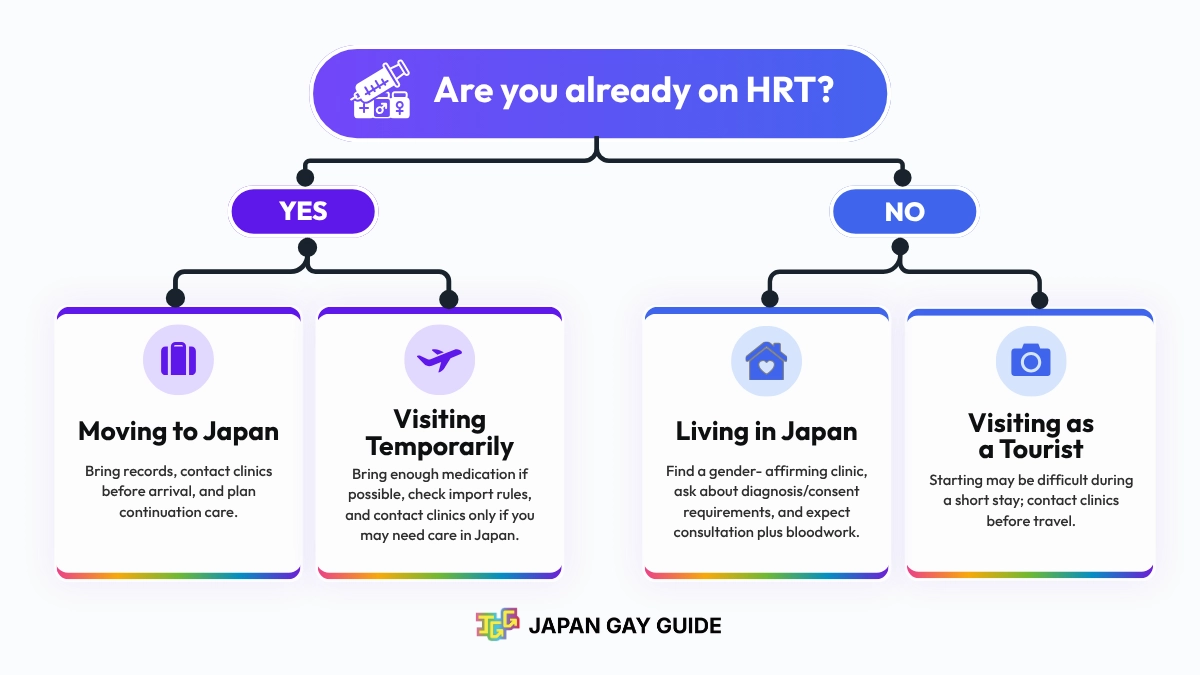
Once you know that HRT is possible in Japan, the next question is which pathway fits your situation. Starting HRT for the first time and continuing treatment from overseas are usually handled differently.
Your path depends on two questions:
- Are you already on HRT?
- Are you living in Japan, moving to Japan, or visiting temporarily?
I already take HRT and am moving to Japan
If you are already on HRT and moving to Japan, start planning before your arrival. Book an appointment with your current doctor and ask for copies of your prescription, recent bloodwork, medication list, diagnosis or treatment letter and any relevant medical history.
Once you know where you’ll live in Japan, contact clinics in that area or in the nearest major city. Explain that you are already on HRT and want to continue care after moving. Ask whether the clinic can review overseas prescriptions, whether the first visit must be in person, whether English support is available and what documents they would want to see.
You should also plan how much medication you will need to bring into Japan. MHLW explains that prescription drugs and injectable drugs for personal use are subject to import rules and an import certificate may be needed depending on medication type and quantity.
I already take HRT and am visiting Japan temporarily
If you are visiting Japan for a short time, continuing your existing medication is usually simpler than trying to start a new HRT plan during the trip. Bring your prescription, doctor’s letter, medication packaging, and any import documents required for your medication and quantity.
If you unexpectedly need additional care in Japan, contact a clinic as soon as possible. Explain that you are already on HRT, how long you will be in Japan, what medication you use, and whether you have recent bloodwork. Some clinics may be able to help, but timing, medication availability, and follow-up requirements could limit what they can do.
I want to start HRT while living in Japan
If you live in Japan, starting HRT is usually more realistic than starting during a short visit because you can complete your consultation, bloodwork, follow-up appointments and continual dosage monitoring. The process may still vary by clinic. A typical pathway could look like:
- Find a clinic that explicitly provides gender-affirming care
- Contact the clinic and ask about starting HRT
- Confirm whether a diagnosis, referral, or prior counseling is required
- Attend a consultation
- Complete baseline bloodwork or other checks
- Discuss medication options, risks, costs, and follow-up
- Begin treatment if the doctor decides it is appropriate
I want to start HRT while visiting Japan as a tourist
Starting HRT as a short-term tourist is not something you should rely on. It may be possible at some clinics in some situations, but short stays can make it difficult to complete consultation, bloodwork, risk explanation, medication planning, and follow-up before leaving Japan.
Before traveling, contact clinics in plenty of time and ask:
- Do you start HRT for short-term visitors?
- Can the first appointment be online or must it be in person?
- Are blood tests required before prescribing?
- How long does the process usually take?
- Can medication be provided during the visit?
- What happens if follow-up is needed after leaving Japan?
How to Get HRT in Japan Step by Step
Not every clinic follows the same order, but the process usually looks like this:
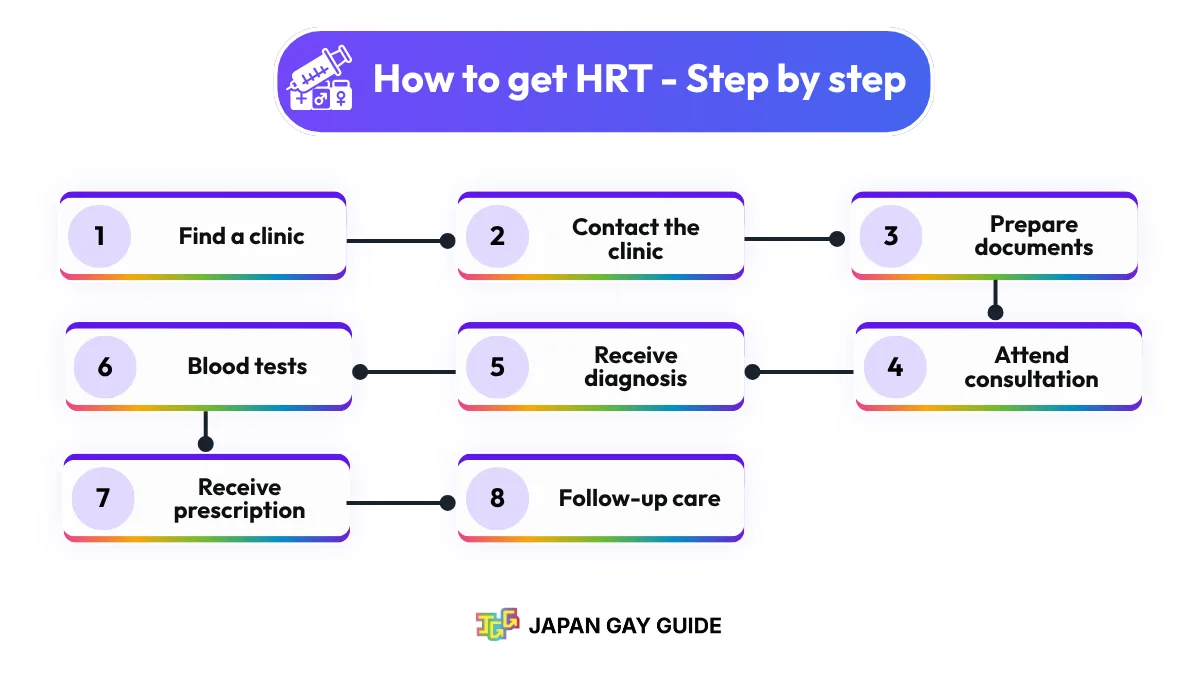
Step 1: Find clinics that provide gender-affirming HRT
Look for clinics that clearly mention transgender care, gender affirmation, gender dysphoria, FTM/MTF hormone therapy or gender outpatient care.
Green flags include:
- A clear gender-affirming care page
- Published prices
- Explanation of first-visit requirements
- Bloodwork availability
- English-speaking support or interpreter guidance
- Online consultation options
- Experience with overseas patients
- Clear distinction between starting HRT and continuing existing HRT
Watch out for general “HRT” pages. Some clinics use HRT to refer to menopause, anti-aging treatment or testosterone replacement therapy for cisgender men. Those pages may not mean the clinic provides gender-affirming HRT or care.
Azabu Skin Clinic’s English HRT page is an example of a general HRT page focused on anti-aging/health rather than gender-affirming care.
Step 2: Contact the clinic before booking
Before booking, ask direct questions on what you want to know. This prevents wasted time and appointments and helps you to find the clinic that fits your situation.
Some useful questions to ask include:
- Do you provide gender-affirming HRT?
- Do you start new patients, continue overseas prescriptions, or both?
- Do you require a diagnosis, referral, or prior treatment records?
- Can the consultation be done in English?
- Are blood tests required before prescribing?
- What are the estimated first-visit costs?
- Can follow-ups be done online?
Step 3: Prepare your documents
Bring what applies to you:
| Document | Who Needs It? | Why It Helps |
|---|---|---|
| Passport | Everyone | Basic identification. |
| Residence card | Residents | Confirms residency status in Japan. |
| Current prescription | People already on HRT | Shows medication, dose, and prescriber. |
| Medication packaging | People already on HRT | Helps the clinic identify exact medication. |
| Diagnosis or treatment letter | Helpful if available | Supports continuation or explains medical history. |
| Recent bloodwork | Very useful | Helps the doctor assess current hormone levels and safety markers. |
| Medication list | Everyone | Helps prevent interactions and safety issues. |
| Allergy/medical history | Everyone | Helps risk assessment. |
| Insurance card | Residents, if applicable | Needed if any services may be billed through insurance. |
| Translation | If documents are not in Japanese or English | Helps clinic staff review documents accurately. |
Step 4: Attend your first consultation
At your first consultation, the doctor may ask about:
- Your transition goals
- Current or past HRT
- Current medications
- Medical history
- Smoking status, blood pressure, or other risk factors
- Fertility considerations, if relevant
- Mental health history, if relevant to the clinic’s process
- Follow-up availability
- Your understanding of expected effects, risks, and side effects
The consultation is also your chance to ask what the clinic can and cannot provide, if you haven’t already done so in advance. chance to ask what the clinic can and cannot provide, if you haven’t already done so in advance.
Step 5: Diagnosis, informed consent, or referral
Some clinics work on a diagnosis basis and may ask for documents or recommend consultation with a specialist first. Others may focus on medical consultation, risk explanation, consent, bloodwork and follow-up appointments.
Japan does not have one universal clinic process, so ask each clinic exactly what they require. If a clinic cannot provide the care you need, ask whether they can help refer you to another provider.
Step 6: Get blood tests and baseline monitoring
Blood tests are commonly used to monitor hormone levels and other safety markers. Things that clinics may check include blood count, liver function, kidney function, electrolytes, blood sugar, hormone levels and other markers depending on the treatment plan.
Your clinic will decide which tests are needed based on your treatment plan and health history.
Step 7: Receive a prescription or in-clinic medication
After the clinic completes its evaluation, reviews any required blood tests, and decides that HRT is medically appropriate, a prescription or in-clinic medication plan may be issued. At some clinics this may happen on the same day, while others may require additional testing, documents, or follow-up before prescribing.
Some clinics have the facility to provide you with the medication directly after the appointment. Ask the clinic before booking how medication is handled, especially if you need injections or are visiting Japan temporarily.
Step 8: Schedule follow-up care
Follow-up care is important because hormone therapy often requires close monitoring, dosage adjustment and side-effect checks.
Frequency of follow-up appointments depends on the clinic, medication type, test results, dosage changes and your health history. Ask your clinic whether they can be done online, or if they always need to be done in person.
HRT Clinics in Japan: How to Find and Compare Providers

The clinics listed below are not the only possible options in Japan, but are examples of clinics with public information about gender-affirming care, hormone therapy, English support or related services.
How to choose an HRT clinic in Japan
When comparing clinics, look for:
- Does the clinic explicitly mention gender-affirming care?
- Does it start HRT for new patients?
- Does it continue overseas prescriptions?
- Does it require a diagnosis or referral?
- Does it provide blood testing?
- Does it offer English support?
- Does it offer online consultation?
- Are prices clearly published?
- Can medication be delivered, prescribed, or administered on-site?
- Is follow-up care available if you live far away?
HRT clinics in Tokyo and nearby areas
Note
The clinics below are examples with public information about gender-affirming care, hormone therapy, English-language support, or related services. Services, pricing, online consultation availability, and intake requirements can change. Always confirm directly with the clinic before booking.
| Clinic | Area | Starts HRT? | Continues Overseas HRT? | English Support | Online / Remote Options | Notes |
|---|---|---|---|---|---|---|
| Ebisu TG Clinic | Ebisu, Tokyo | Yes, according to clinic page | Yes, but exact regimen is not guaranteed | Doctor can conduct consultations in English | Yes | Provides hormone therapy, blood tests, first consultations online, and medication delivery within Japan. |
| Personal Health Clinic (PHC) | Ueno, Tokyo; Yokohama | Possible after consultation | Ask clinic | English page exists; detailed gender page is mainly Japanese | Ask clinic | Gender outpatient care by a certified GI specialist; PHC states it does not provide diagnosis. |
| IDATEN partner access via PHC | Tokyo partner access | Ask clinic | Ask clinic | Ask clinic | Ask clinic | IDATEN states that residents of Hokkaido, Tohoku, and Kanto can access generic Nebido through partnered Personal Health Clinic in Tokyo. |
HRT clinics in Osaka and Kansai
Note: The clinics below are examples with public information about gender-affirming care, hormone therapy, English-language support, or related services. Services, pricing, online consultation availability, and intake requirements can change. Always confirm directly with the clinic before booking.
| Clinic | Area | Starts HRT? | Continues Overseas HRT? | English Support | Online Consults? | Notes |
|---|---|---|---|---|---|---|
| IDATEN Clinic | Tenma / Ogimachi, Osaka | Yes, according to clinic page | Ask clinic | English page available | Online consultation discussed on clinic page | Provides gender affirmation services, hormone therapy options, testing, and published prices. |
| Fukuda Clinic | Chuo, Osaka | Yes, according to clinic page | Ask clinic | English support not widely available, dependent on staff availability | Ask clinic | Provided GID treatment since 1995. |
| Koishi Clinic | Marutamachi, Kyoto | Yes, according to clinic page | Ask clinic | English support not available | Ask clinic | counseling not available at the clinic but can refer to specialist. |
English-speaking HRT clinics in Japan
English support is available at some clinics, but you should confirm before booking. Some clinics provide English-language information or state that English medical consultations are available.
If the clinic does not clearly offer English support, ask whether you can bring an interpreter, bilingual friend, or translated documents.
Online consultations for HRT in Japan
While some clinics can offer online consultations, online care has limits. Online consultations may be useful for:
- Initial screening
- Asking whether the clinic fits your situation
- Continuing care after an in-person visit
- Follow-up discussions
- Medication delivery within Japan, if the clinic supports it
However, some first visits, blood tests, injections, or examinations may still require in-person care.
What to do if you live outside Tokyo or Osaka
Living outside of Tokyo or Osaka can make accessing gender-affirming care a little more complicated, but definitely not impossible. There are several different options to help with finding the clinic that works for you, such as:
- Asking local LGBTQ community groups to see if they have any recommendations
- Considering traveling to a major city for initial care
- Asking clinics in other cities whether follow-ups can be done online so that no additional travel would be needed
- Looking into where your local pharmacy and health center are, so you know what you can and cannot receive locally
How Much Does Gender-Affirming HRT Cost in Japan?
Gender-affirming HRT in Japan is often paid for out-of-pocket. Costs vary by clinic, medication, bloodwork, visit type, and whether any related tests are eligible for insurance.
Some clinics state that counseling and hormone therapy for gender affirmation are not covered by Japanese National Health Insurance, while some periodic examinations associated with hormone therapy may be covered depending on the patient’s condition.
Typical first-appointment costs
Published first-visit fees vary by clinic. As public clinic examples, initial consultation fees may appear around ¥2,500–¥5,500, but this is not a guaranteed Japan-wide range.
Blood test and monitoring costs
Bloodwork costs also vary. Current public examples include hormone therapy blood test packages around ¥3,000, hormone-level blood tests around ¥7,700, and side-effect or monitoring tests around ¥3,850 – ¥5,500.
Medication and injection costs
Published medication prices differ by clinic. The examples below should be treated as public clinic examples only, not guaranteed Japan-wide prices. Confirm the current price, dose, quantity, consultation fee, blood test fee, and any injection or administration fee directly with the clinic.
| Treatment Type | Typical Cost |
|---|---|
| Short-acting testosterone injection | Around ¥2,500 – ¥4,000 per injection (usually every 2-4 weeks) |
| Long-acting testosterone option | Around ¥16,500 – ¥18,000 per injection (every 10-14 weeks, sometimes longer depending on protocol) |
| Testosterone gel/cream | Around ¥10,000–¥30,000+ per month depending on use |
| Estrogen injection | Around ¥2,000 – ¥4,000 per injection (often every 1 – 2 weeks) |
| Estrogen gel | Around ¥4,000–¥8,000 depending on quantity |
| Estrogen patch | Around ¥2,300–¥12,500 depending on quantity |
| Oral estrogen | Around ¥2,000–¥5,000 depending on quantity |
| Anti-androgen | Around ¥1,000–¥5,000 depending on dose or quantity |
*Prices can change. Last checked: July 2026.
Injection administration fee
This is often included in the medication bill. But if it’s billed separately, this would be around ¥500 – ¥2,000 per visit.
Follow-up appointment costs
Follow-up consultation fees may be lower than first-visit fees, but this depends on the clinic. Some clinics list follow-up visits around ¥1,000, while others may charge through medication or online consultation fees. Public online consultation service fees may be around ¥2,750 per visit at some clinics.
Does National Health Insurance cover HRT in Japan?

Gender-affirming hormone therapy is commonly handled as self-pay in Japan. Some clinics state that counseling and hormone therapy for gender affirmation are not covered by Japanese National Health Insurance, while some periodic examinations associated with hormone therapy may be covered depending on the patient’s underlying condition.
Because billing may depend on the clinic, diagnosis, test type, and individual medical situation, ask before booking:
- Is the consultation self-pay?
- Are blood tests self-pay or partially covered?
- Are medications self-pay?
- Can any related examinations be billed through insurance?
- What is the estimated total cost for the first visit?
Tourist vs resident costs
Tourists should expect to pay out of pocket unless their insurance specifically covers the situation. Residents with Japanese insurance should still confirm clinic billing before booking, because gender-affirming hormone therapy is commonly handled as elective care.
You could expect a typical range of the different steps and associated costs to look like the following:
| Cost Type | Typical Range | How Often | Notes |
|---|---|---|---|
| Initial consultation | ¥2,500 – ¥5,500 | First visit | Varies by clinic |
| Blood tests | ¥3,000 – ¥7,700 | Baseline or follow-up | Depends on panel and clinic |
| Medication | ¥2,000 – ¥43,000 | Monthly/ per injection/ per quantity | Depends on hormone, route, dose and quantity |
| Online consultation fee | Around ¥2,750 | When online | Clinic-specific |
| Injection/admin fee | ¥500 – ¥2,000 | Per visit | If applicable |
| Follow-up visit | Around ¥1,000+ | Follow-up visits | Clinic-specific |
| Documents/ referrals | Varies | If needed | Ask clinic before booking |
What Hormones Are Available for Gender-Affirming Care in Japan?
Medication availability varies by clinic. Your Japanese prescription may differ from your overseas regimen because clinics stock different brands, routes or dose schedules.
Some gender-affirming care providers in Japan list testosterone options such as injections, gel, cream, or oral options, depending on the clinic. Some list estrogen options such as gel, patches, oral tablets, or injections. Anti-androgens such as spironolactone may also be available at some clinics. Availability depends on the provider, treatment plan, and current medication supply.
Estrogen options in Japan
Some clinics may offer estrogen in forms such as:
- Oral tablets
- Gel
- Patches
- Injections
Availability depends on the clinic. Do not assume that every clinic stocks every form.
Testosterone options in Japan
Some clinics may offer testosterone in forms such as:
- Short-acting injections
- Long-acting injections
- Gel or cream
- Capsules, depending on the clinic
Testosterone options vary significantly by clinic, and some medications may require in-person visits or specific monitoring.
Anti-androgens and related medications
Anti-androgens may be used for some transfeminine or non-binary patients depending on the treatment plan. Spironolactone is listed by some Japanese gender-affirming care providers as one possible anti-androgen option.
Why your Japanese prescription may differ from your overseas regimen
Even if you already take HRT, you may find that your Japanese clinic may not continue the exact same medication, dose or route. Some clinics state that overseas prescriptions are reviewed as a reference but that the exact same regimen cannot always be guaranteed.
Possible differences include:
- Different brand names
- Different dosage schedule
- Different route, such as injection instead of gel
- Different bloodwork requirements
- Medication not being available at the chosen clinic
- Doctor recommending a safer or more locally available alternative
What to ask your clinic about medication availability
Ask:
- Do you prescribe my current hormone?
- Do you stock or administer it directly?
- Do you offer injections, tablets, gels, or patches?
- Can you continue my current dose?
- If not, what alternatives do you usually use?
- What bloodwork do you require?
- How often are follow-ups needed?
- Can medication be delivered, or do I need to visit in person?
- What happens if my current medication is unavailable in Japan?
Before You Book: HRT Clinic Preparation Checklist

Before contacting a clinic, prepare the basics:
- Whether you are starting HRT or continuing treatment from overseas
- Whether you live in Japan, are moving to Japan, or are visiting temporarily
- Your current medication name, dose, route, and schedule, if already on HRT
- Recent bloodwork, if available
- Prescription, treatment letter, or diagnosis documents, if available
- Passport and residence card, if applicable
- Japanese health insurance card, if you have one
- Any translation of important medical documents, if needed
- Whether you need English support
- Whether you can attend in-person follow-ups
When contacting the clinic, ask:
- Do you provide gender-affirming HRT?
- Do you start new patients, continue overseas prescriptions, or both?
- Do you require a diagnosis, referral, or prior treatment records?
- Can the consultation be done in English?
- Are blood tests required before prescribing?
- What is the estimated first-visit cost?
- Are medications prescribed, administered in clinic, or delivered?
- Can follow-ups be done online?
Red flags and green flags when choosing a clinic
| Green Flags | Red Flags |
|---|---|
| Clear gender-affirming care page | HRT page only discusses anti-aging, menopause, or cis male TRT |
| Published prices | No pricing information |
| Clear first-visit requirements | No explanation of diagnosis/referral requirements |
| Experience with foreign patients | No language-support information |
| Clear bloodwork and follow-up process | No follow-up or monitoring plan |
| Explains starting vs continuing HRT | Unclear whether they provide gender-affirming care at all |
Conclusion
Getting HRT in Japan is possible for many transgender, non-binary, and gender-diverse people, including foreigners. The right path depends on whether you are starting HRT for the first time or continuing treatment from overseas, whether you live in Japan or are visiting temporarily, and which clinic you choose.
Before booking travel, moving to Japan, or scheduling your first appointment, contact clinics directly and ask about diagnosis requirements, starting vs continuing HRT, medication availability, English support, follow-up care, insurance handling, and total first-visit costs.
If you are already on HRT and bringing medication with you, read our guide to bringing HRT into Japan before you travel.
Frequently Asked Questions About HRT in Japan
Can foreigners get HRT in Japan?
Yes. By contacting a gender-affirming clinic and setting up a consultation, foreigners can receive HRT support during their time in Japan. Access still depends on the clinic’s policies, language support, documents, and whether you are starting or continuing treatment.
Can I continue HRT if I started treatment overseas?
Often, yes, but it is not automatic. A Japanese clinic may review your overseas prescription and bloodwork and then decide whether to continue the same treatment, adjust it, or use a treatment available in Japan.
Do I need a gender dysphoria diagnosis to receive HRT in Japan?
This depends on the clinic. Some clinics may ask for diagnosis or treatment documents, while others may not diagnose gender dysphoria and may provide care through their own consultation process.
Does Japan use informed consent for HRT?
Some clinics may use an informed-consent-style process, while others may use diagnosis-based or specialist-guideline-based pathways. Do not assume one model applies everywhere. Ask the clinic directly what is required before booking.
Does Japanese National Health Insurance cover HRT?
Gender-affirming HRT is often self-pay. Some related examinations may be covered, depending on the clinic and the patient’s situation, but this should be confirmed directly before booking.
Can tourists start HRT in Japan?
It may be possible in some cases, but it can be difficult during a short visit. Starting HRT may require consultation, bloodwork, risk explanation, medication planning, and follow-up scheduling. Contact clinics before travel and ask whether they start HRT for short-term visitors.